Skip to story
อ่านเป็นภาษาไทย
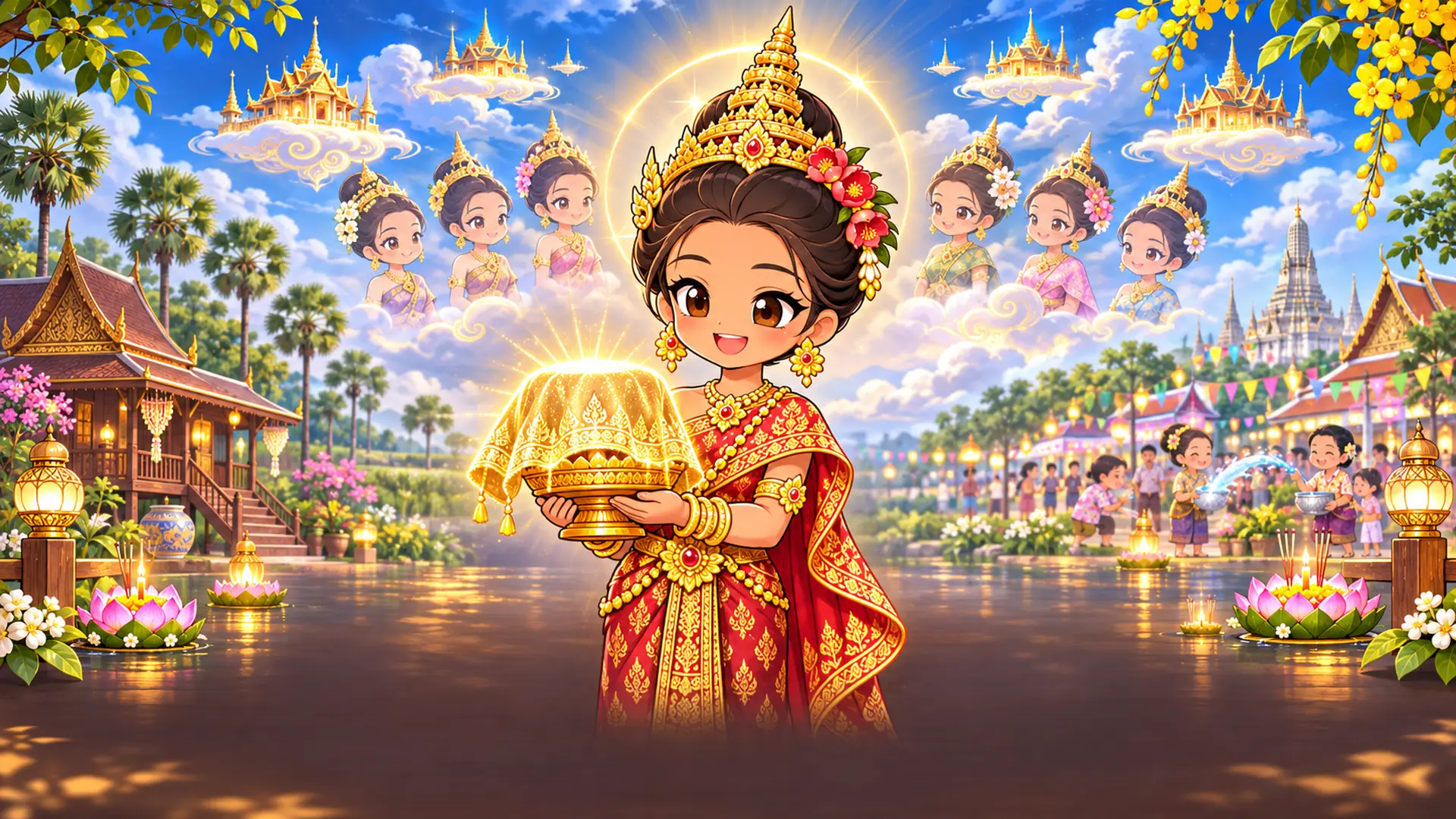
Nang Songkran close and centred, holding the golden tray covered with a shining cloth that glows brightly, her six sisters faintly behind her among clouds, serene smile.

Thai Myth · 2 min read

Nang Songkran

นางสงกรานต์

A god bet his head on three riddles against Thammaban, a boy who understood the language of birds. Two eagles gave away the answers — and seven goddess daughters have carried the price ever since.

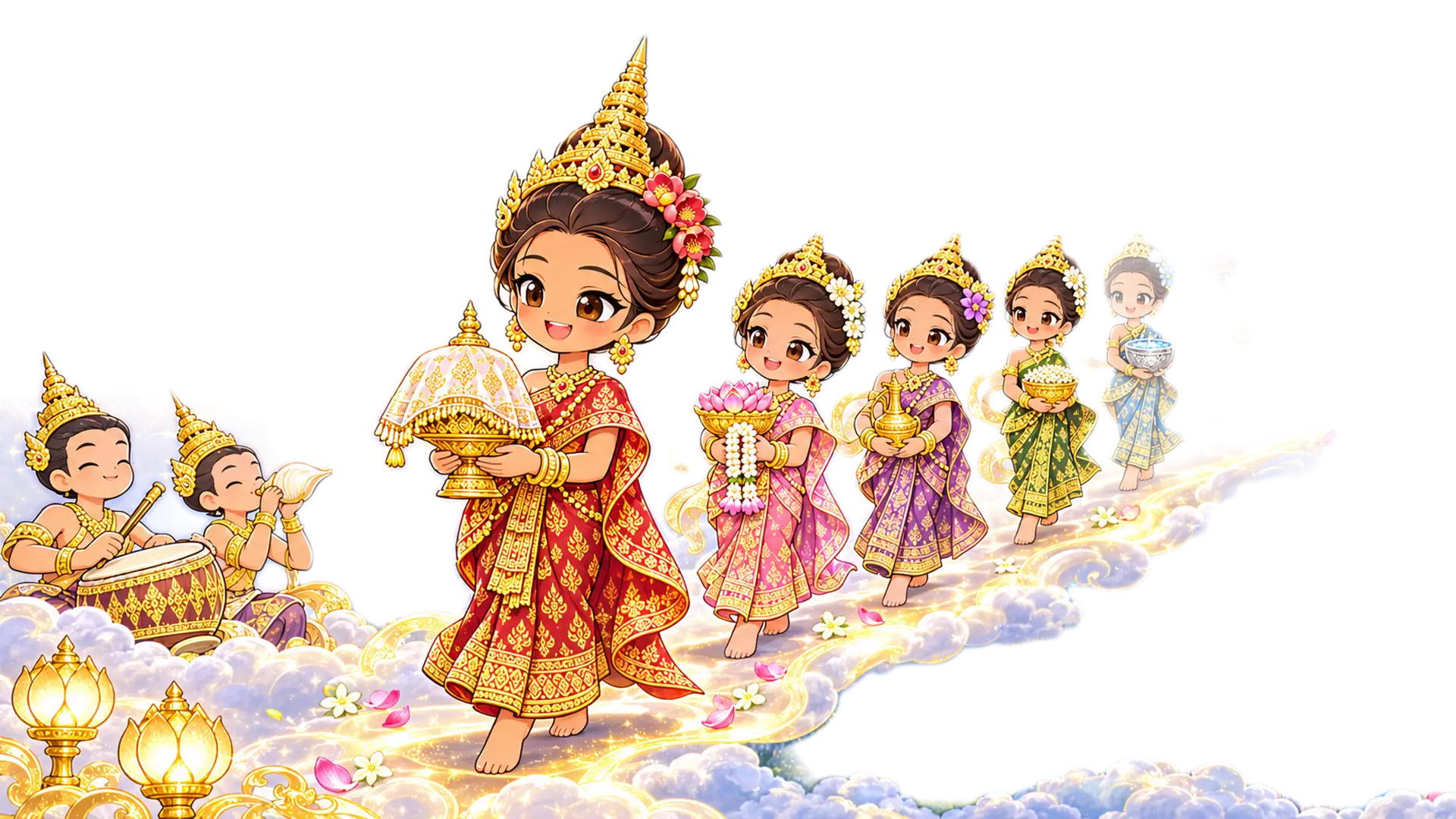
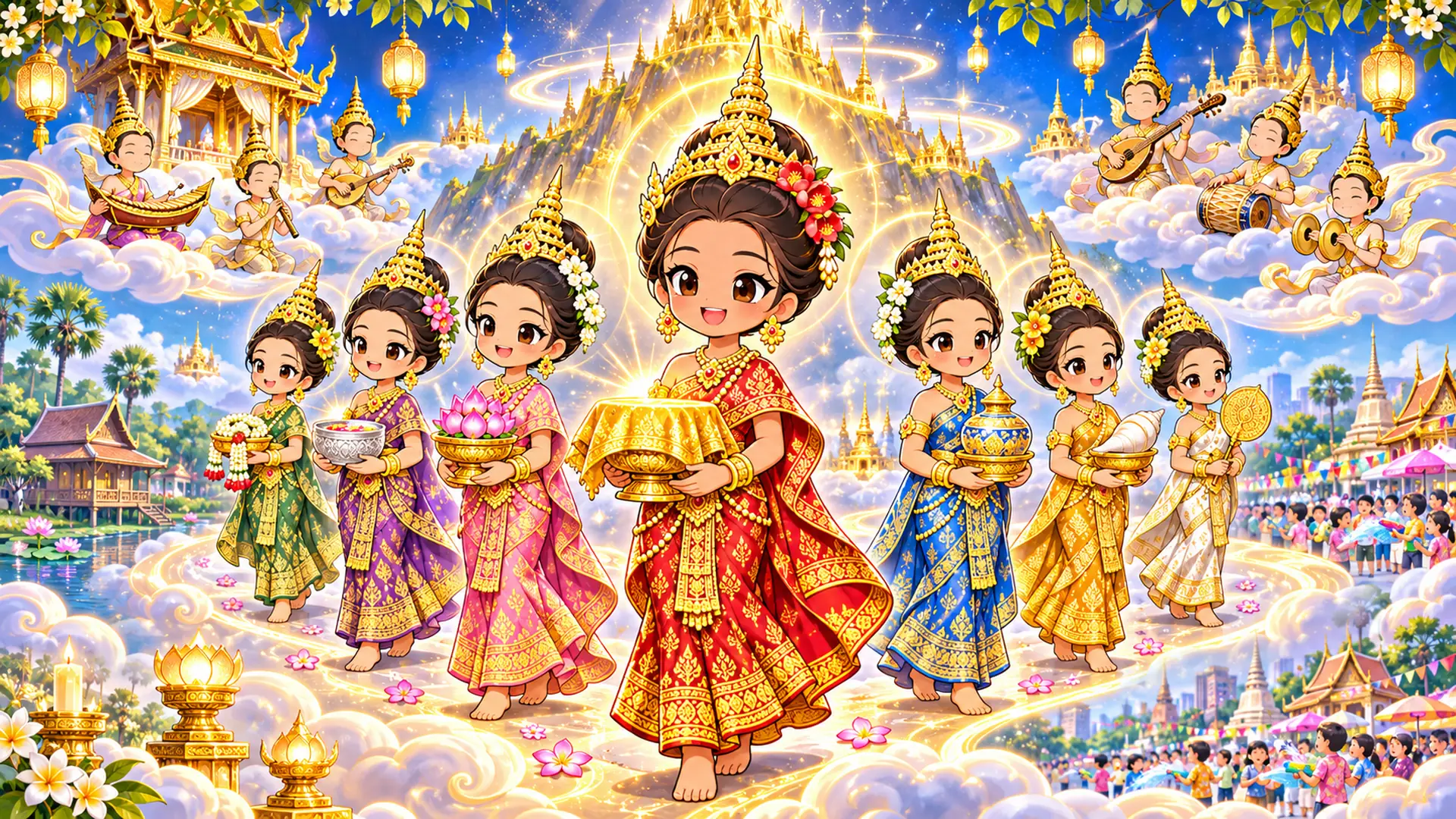
The heavens: seven graceful goddesses in a glowing procession around a towering golden mountain peak among the clouds, celestial musicians and angels around them; the eldest, Nang Songkran, at the front carrying a golden tray covered with a shining golden cloth that radiates light; majestic and magical.

Chapter

Seven Goddesses

Every year, high above the clouds, seven goddesses walk in a golden procession around the holy mountain. The eldest carries a golden tray. And on it lies… their father’s head.
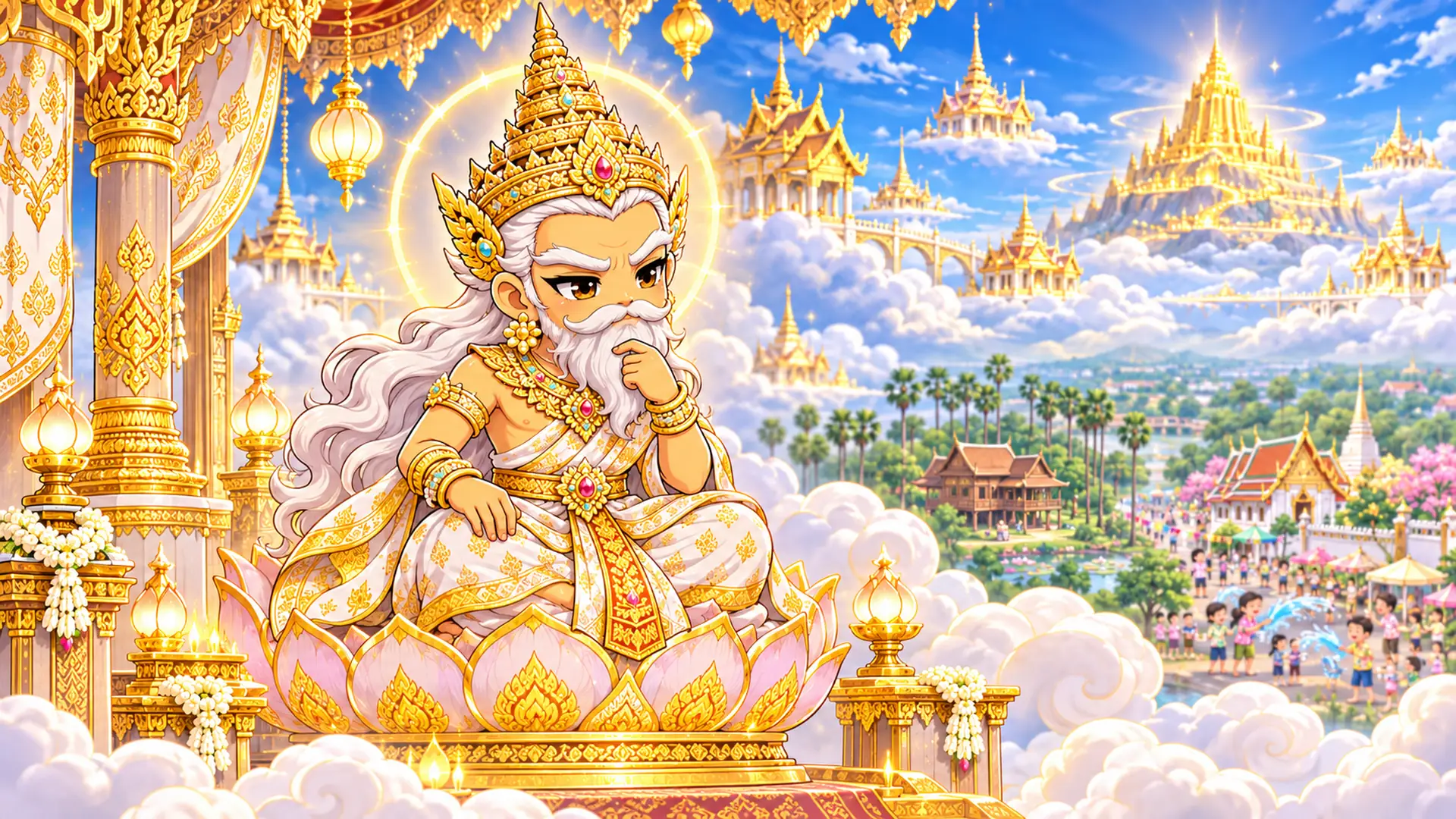
A golden sky palace: Kabil Maha Phrom on a lotus throne among clouds, stroking his beard, frowning with curiosity as he looks down at the earth far below.

This is how Thailand’s New Year began — with a god, a riddle, and a very clever boy.
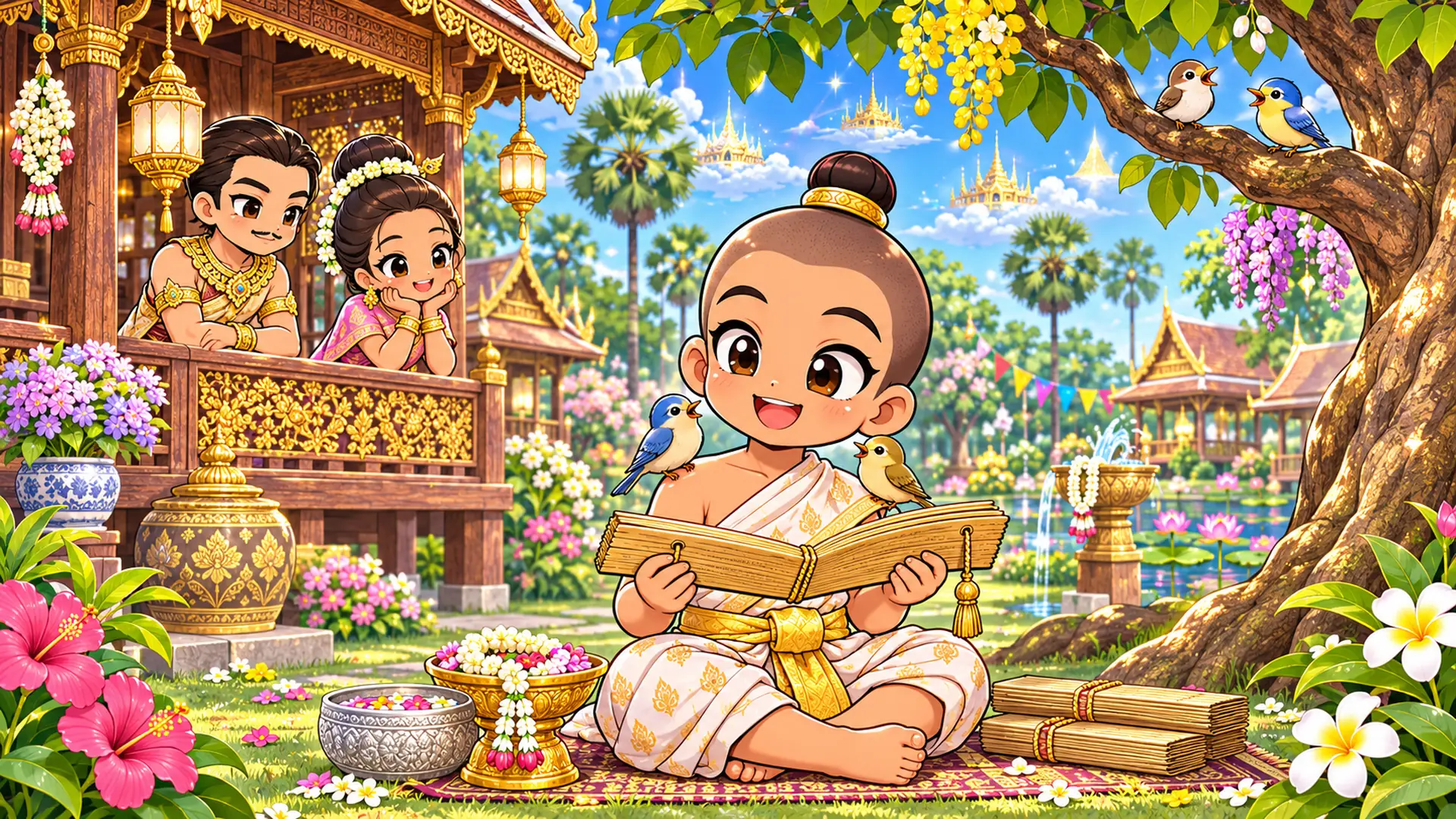
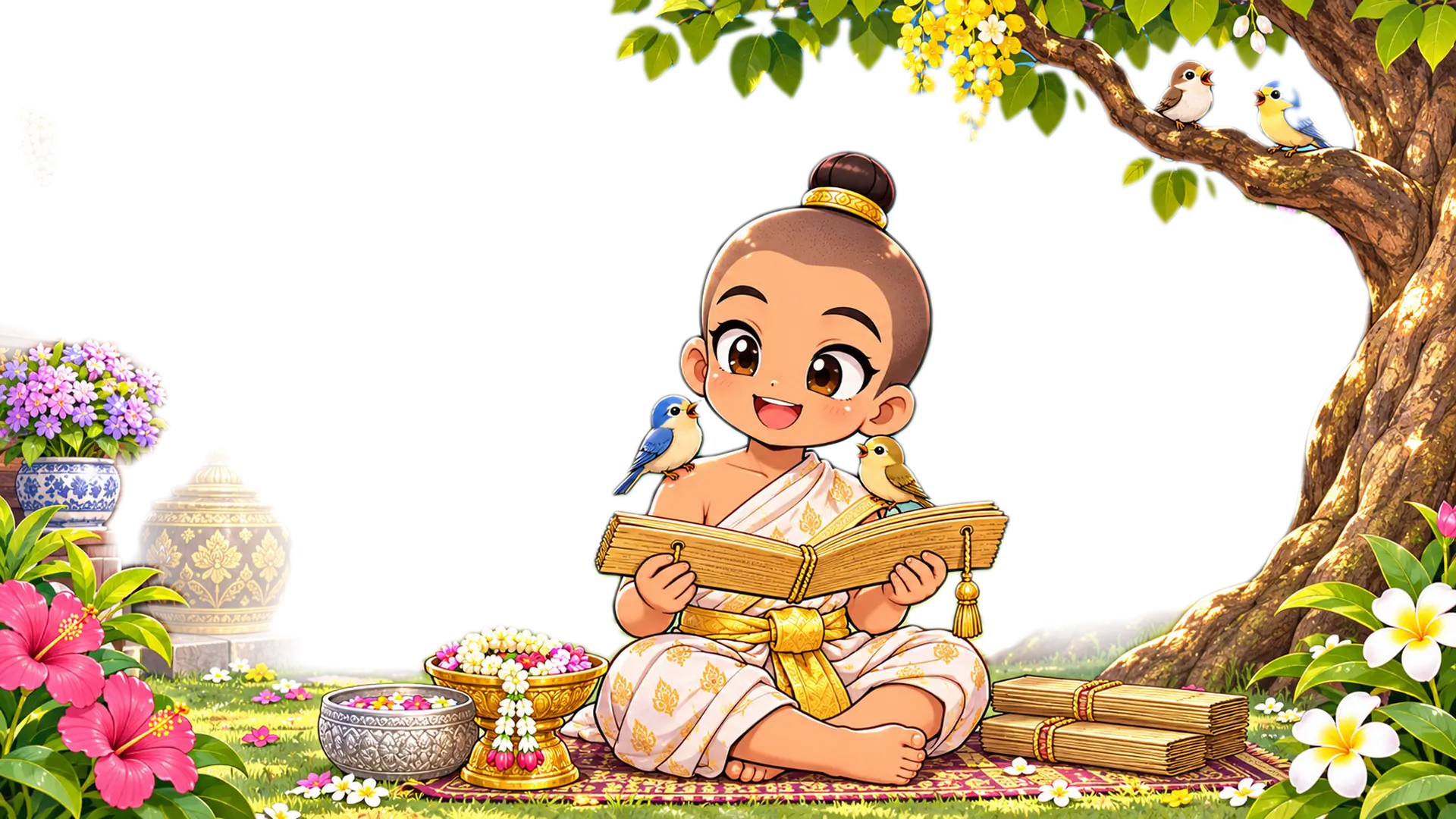
A rich man's teak house garden in old Siam: young Thammaban Kuman sitting under a tree reading a palm-leaf manuscript while birds perch on his shoulders and chirp to him, and he smiles as if he understands them; his proud parents watching from the veranda.

Chapter

The Clever Boy

Long ago, a rich man was blessed with a son named Thammaban. He learned the holy books when he was still a child — and he could understand the language of birds.
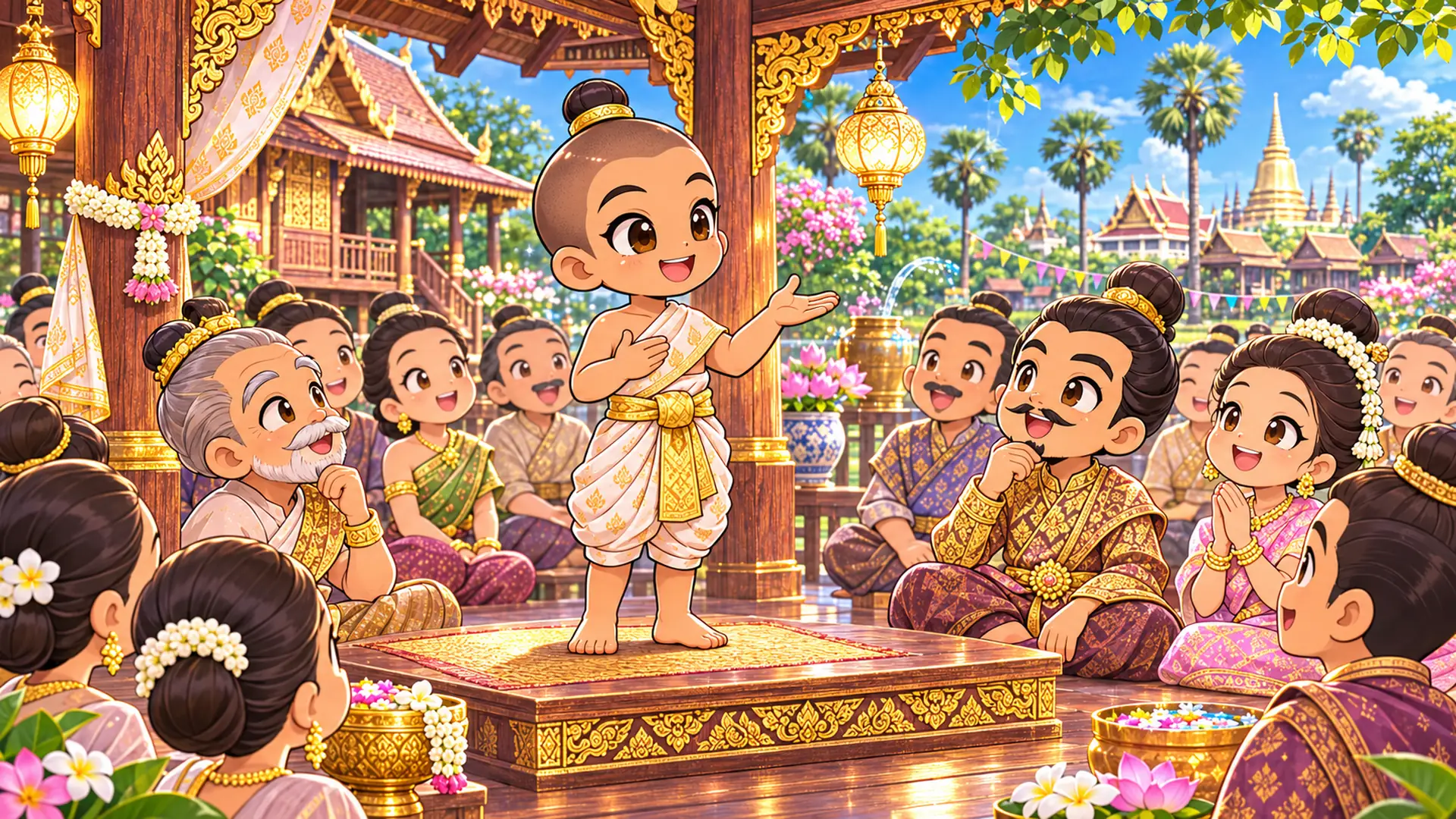
A village pavilion: young Thammaban Kuman standing on a small platform explaining something wise to a crowd of adults, who listen in amazement; warm sunlight.

By the age of seven, grown men came from far away to hear him teach. Word of him reached all the way to the heavens.
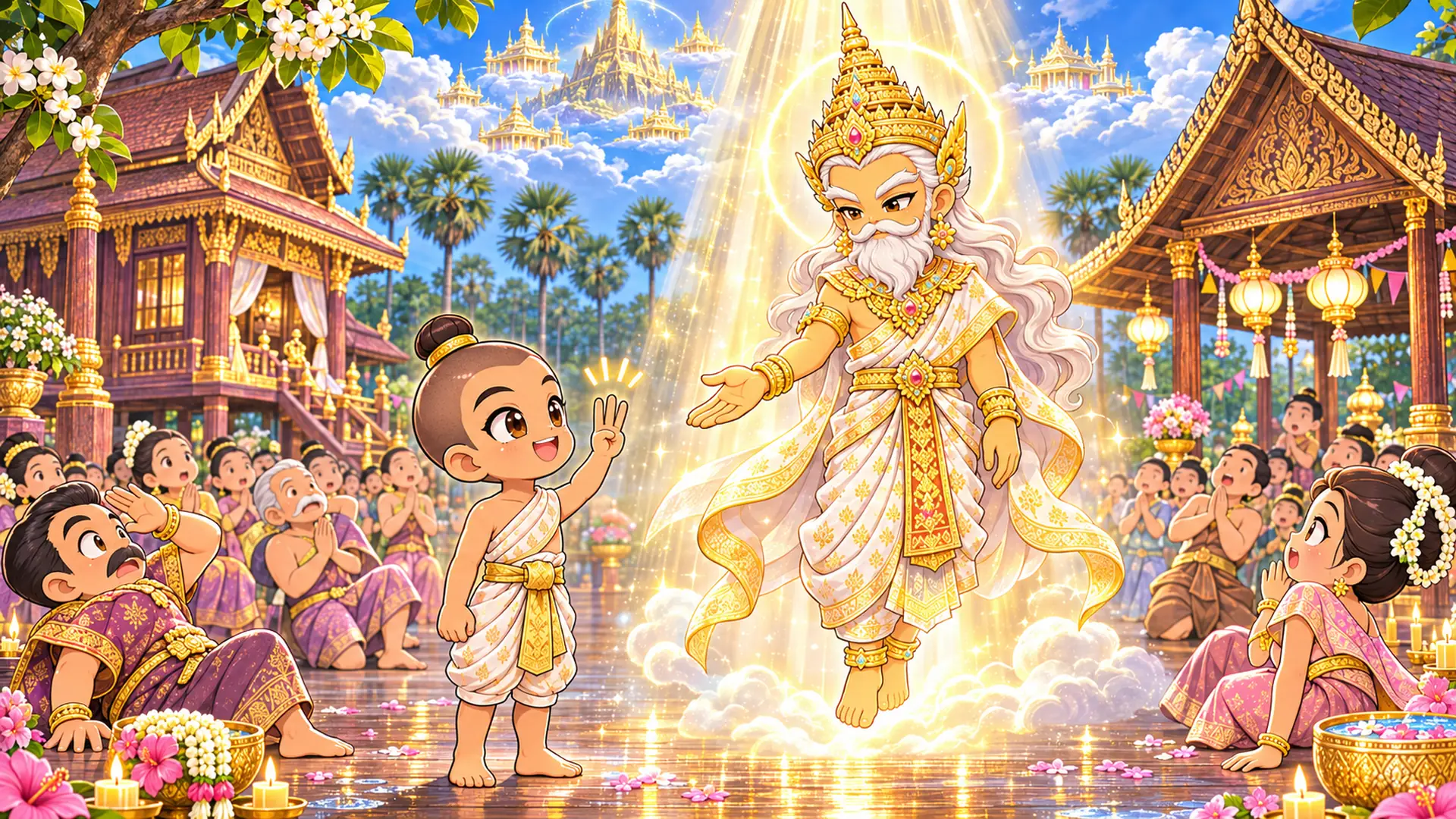
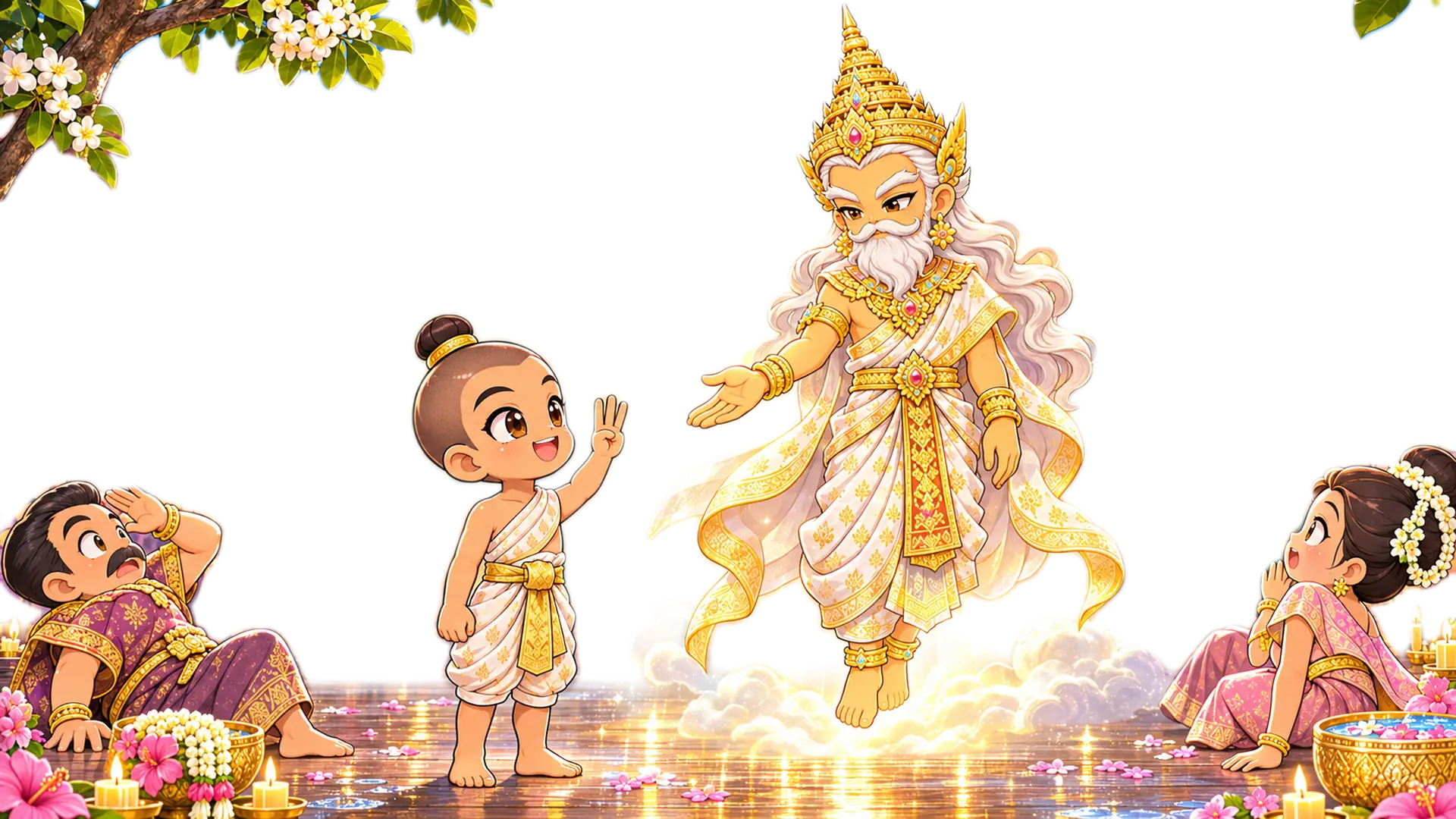
The village pavilion: Kabil Maha Phrom descending from the sky in a beam of light in front of Thammaban Kuman, holding up three fingers; the crowd falling back in awe; dramatic.

Chapter

The Wager

The god Kabil Maha Phrom came down to test him. Three riddles, he said. Seven days to answer.
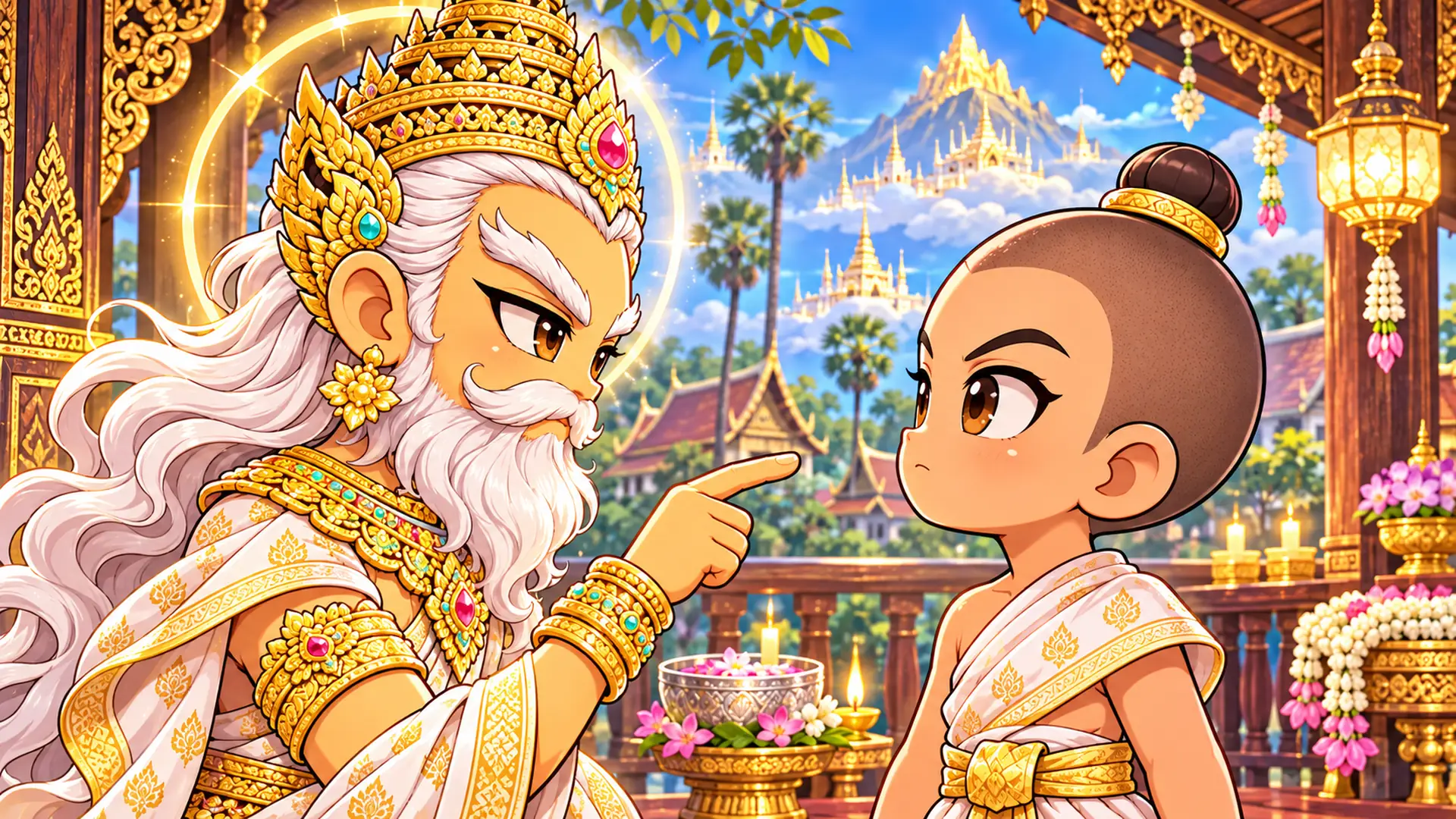
Close-up: Kabil Maha Phrom and Thammaban Kuman face to face, the god pointing at the boy with a proud challenge, the boy calm but serious; golden light, tension.

If you fail, you lose your head. If you answer — I will lose mine. Where does a person’s glory lie in the morning? Where does it lie at noon? And where does it lie in the evening?
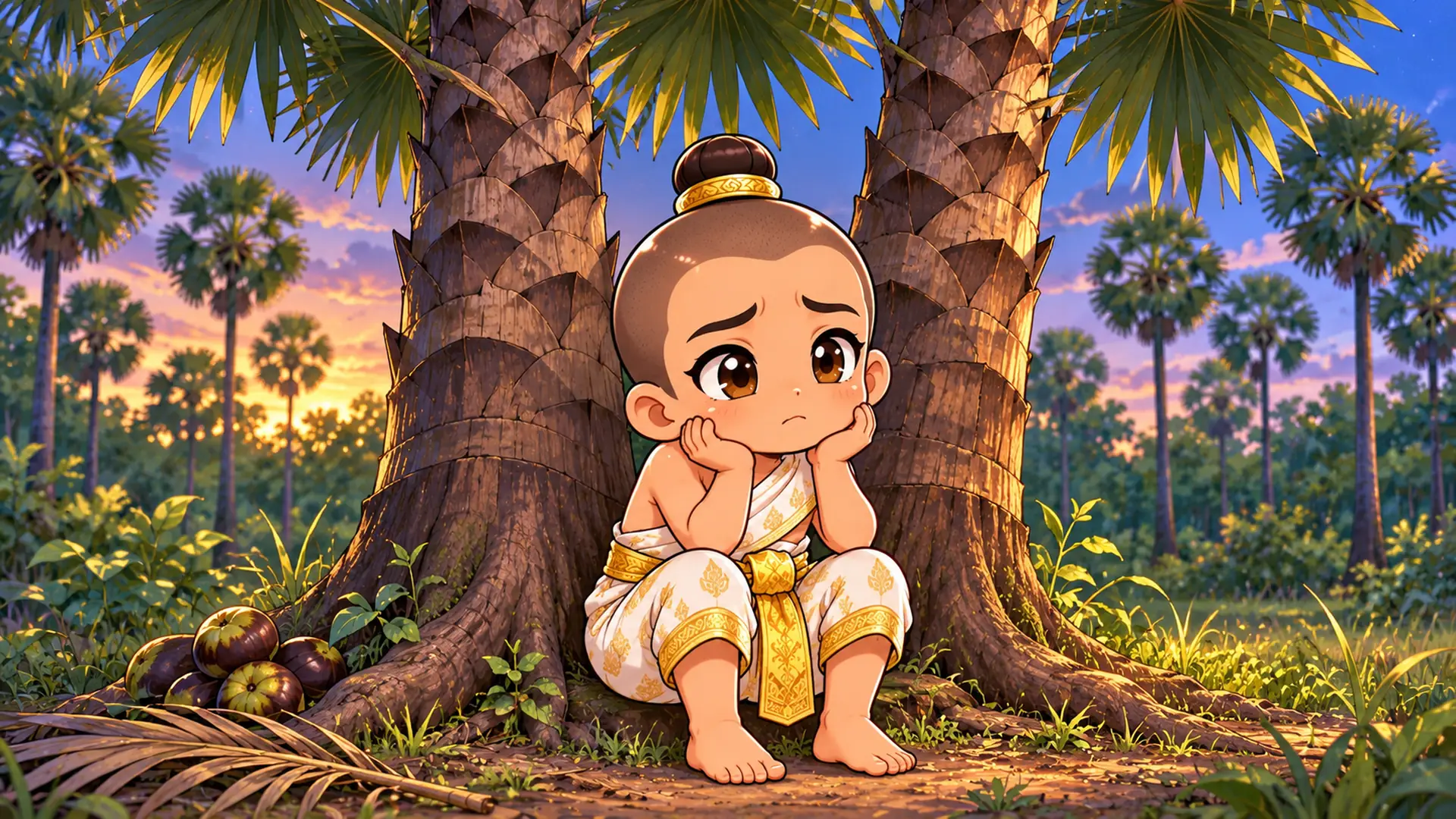
A quiet sugar-palm forest at dusk: Thammaban Kuman sitting alone at the foot of two tall sugar palms, tired and worried, chin in his hands, on the sixth day.

Chapter

Two Eagles

Six days passed, and Thammaban still had no answer. Exhausted, he lay down at the foot of two tall sugar palms.
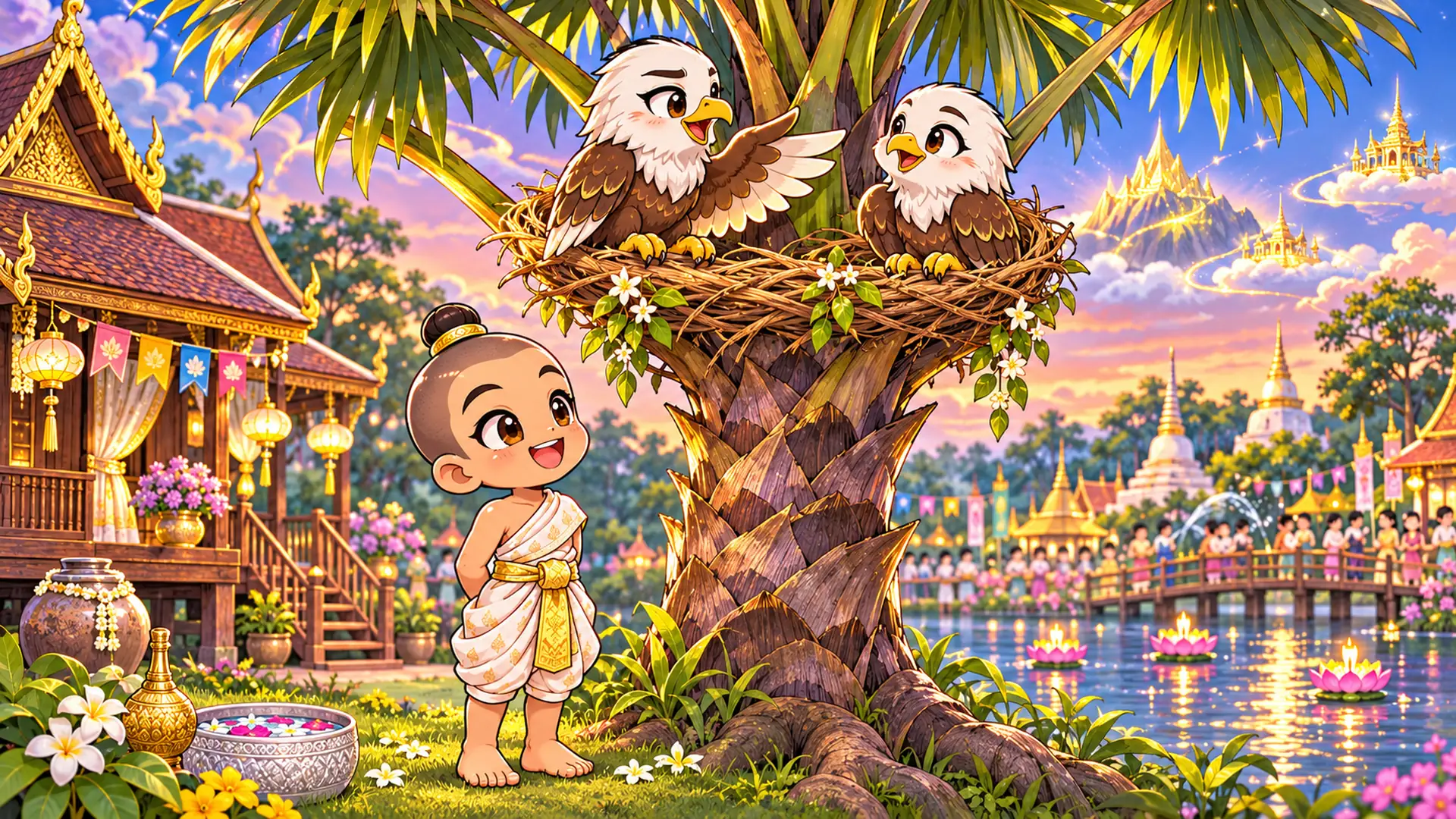
High in a sugar palm at dusk: two cute eagles in a big nest talking to each other, one eagle explaining something with its wing to the other; below, small Thammaban Kuman listening with his eyes wide and a growing smile.

Above him, two eagles were chatting in their nest. Tomorrow, said one, we’ll eat the boy — he’ll never guess the answers. Do you know them? asked the other. Of course! In the morning, glory is in the face — that’s why people wash their faces. At noon it’s in the chest, so they splash water on their chests. In the evening it’s in the feet — so they wash their feet.
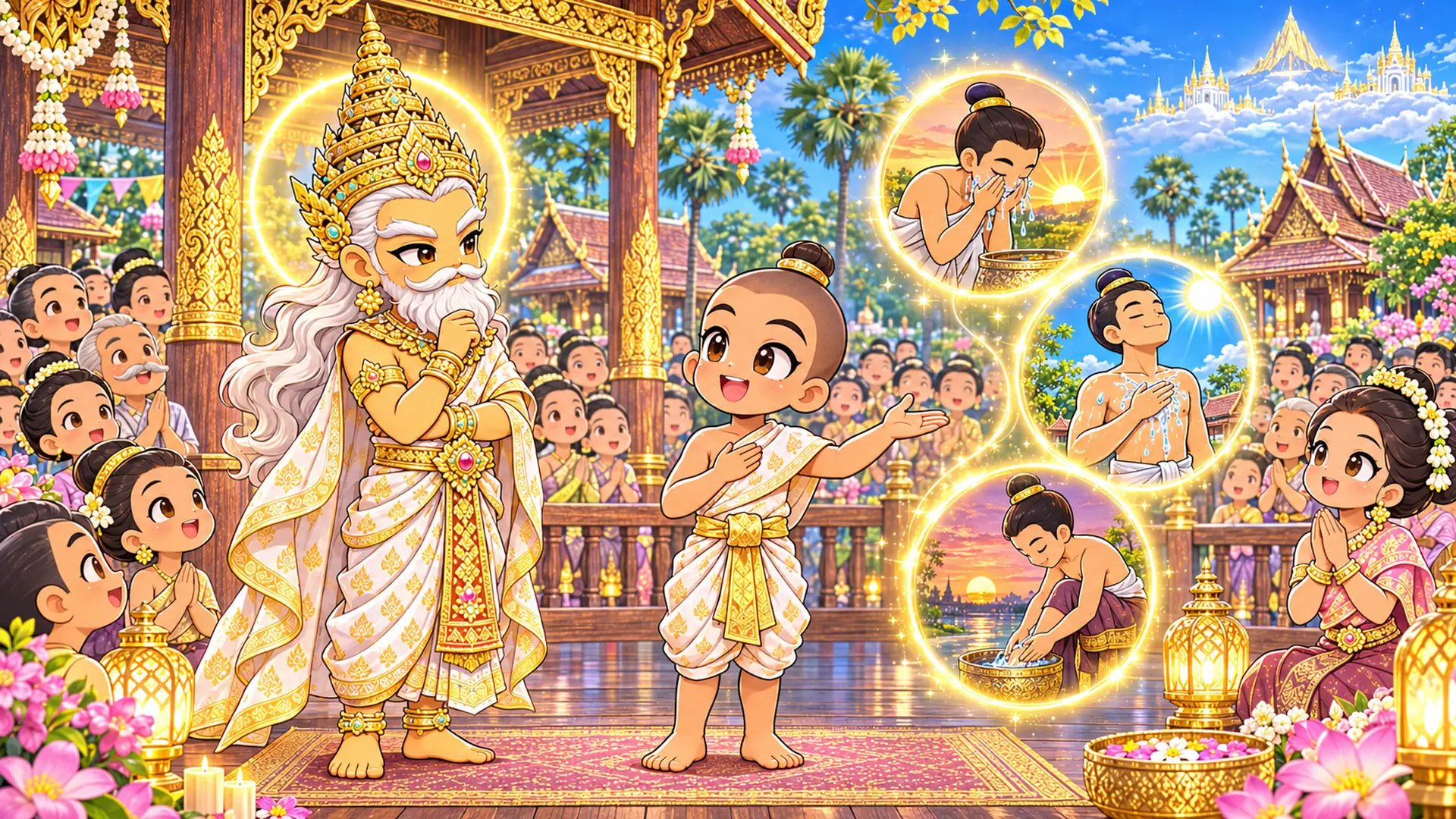
The village pavilion on the seventh day: Thammaban Kuman answering Kabil Maha Phrom confidently, with three glowing magical vignettes floating in the air beside him — a person washing their face at sunrise, a person splashing water on their chest at noon, a person washing their feet at sunset; the crowd amazed.

On the seventh day, Thammaban stood before the god and answered all three riddles. Every one was right.
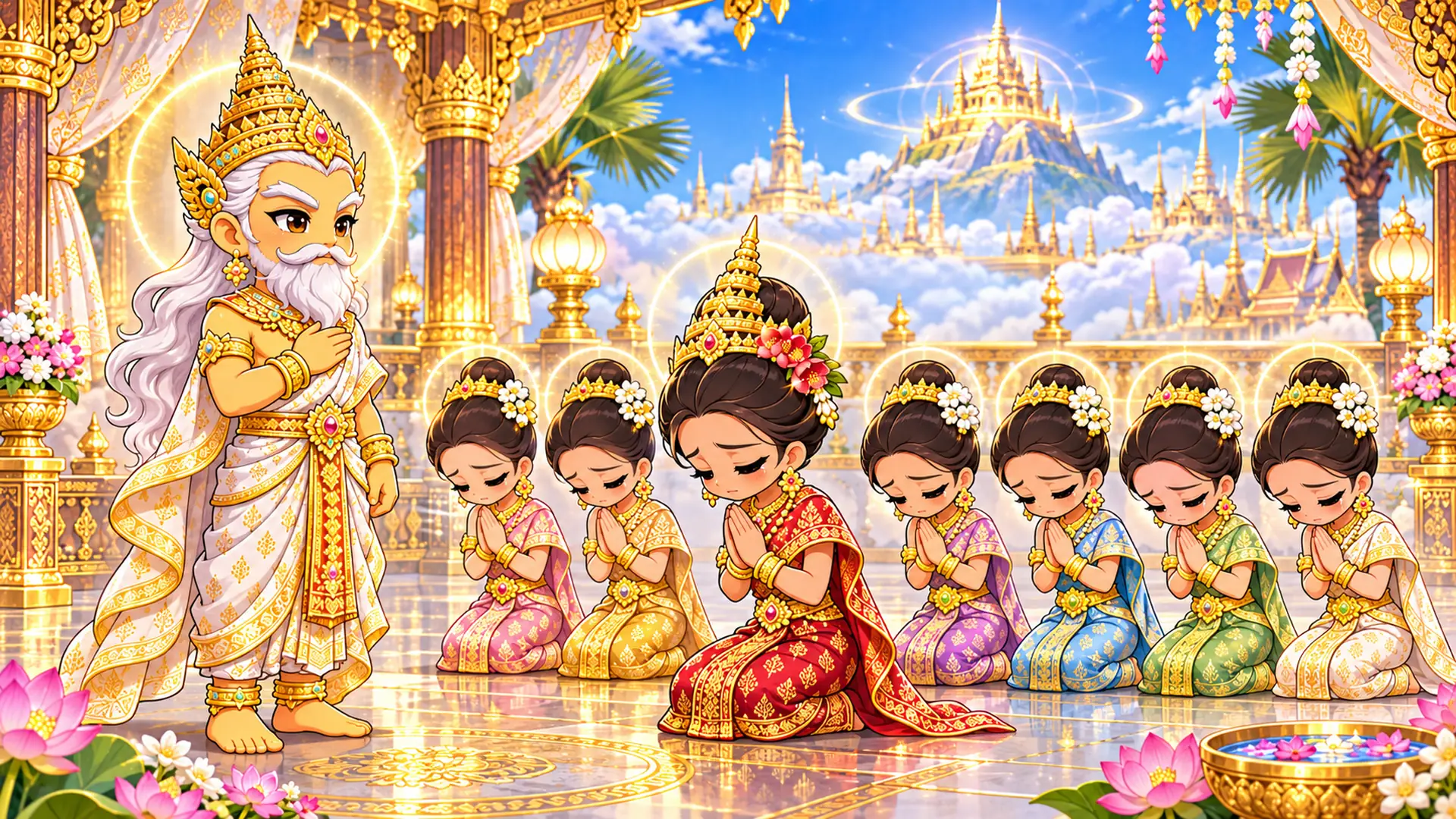
The golden sky palace: Kabil Maha Phrom standing with great dignity before his seven goddess daughters, one hand on his heart, making a solemn decision; the daughters, led by Nang Songkran, bowing sadly; respectful and solemn, no violence.

Chapter

A God Keeps His Word

Kabil Maha Phrom had lost. And a god does not break his word.
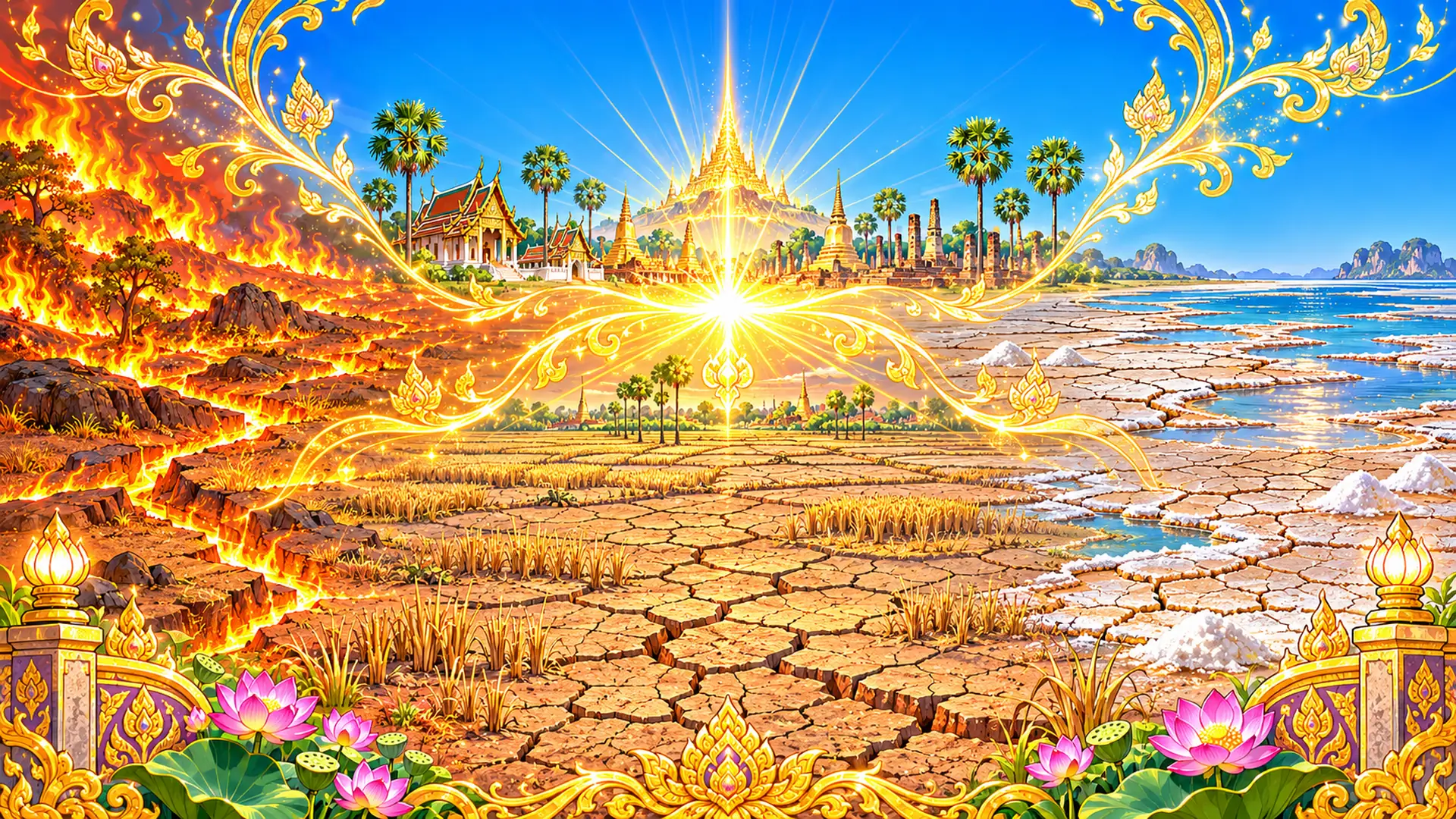
A mythic vision in three parts: on the left the earth bursting into flames, in the middle a cloudless sky over cracked fields with no rain, on the right the ocean drying up — all radiating from a glowing golden light in the centre; dramatic and magical, no gore. A pure landscape vision: NO people, NO gods, NO characters at all.

But his head was so powerful that it could not be put down anywhere. On the earth, it would set the world on fire. In the sky, the rain would stop. In the sea, the oceans would dry up.
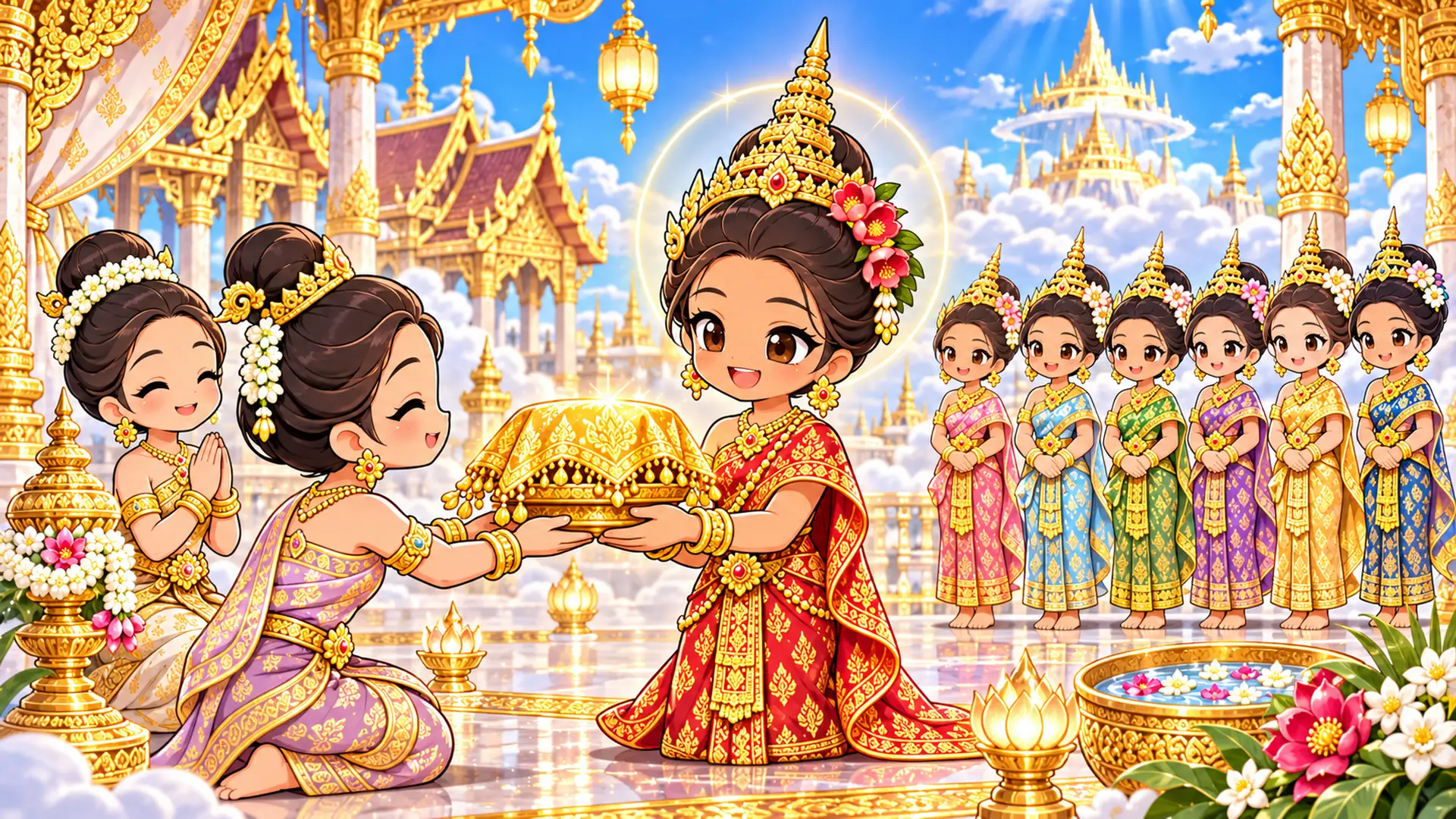
The golden sky palace: Nang Songkran receiving a golden tray covered with a shining golden cloth from celestial attendants, holding it carefully and reverently, her six sisters behind her; soft divine light.

So his seven daughters took it, and laid it on a golden tray.
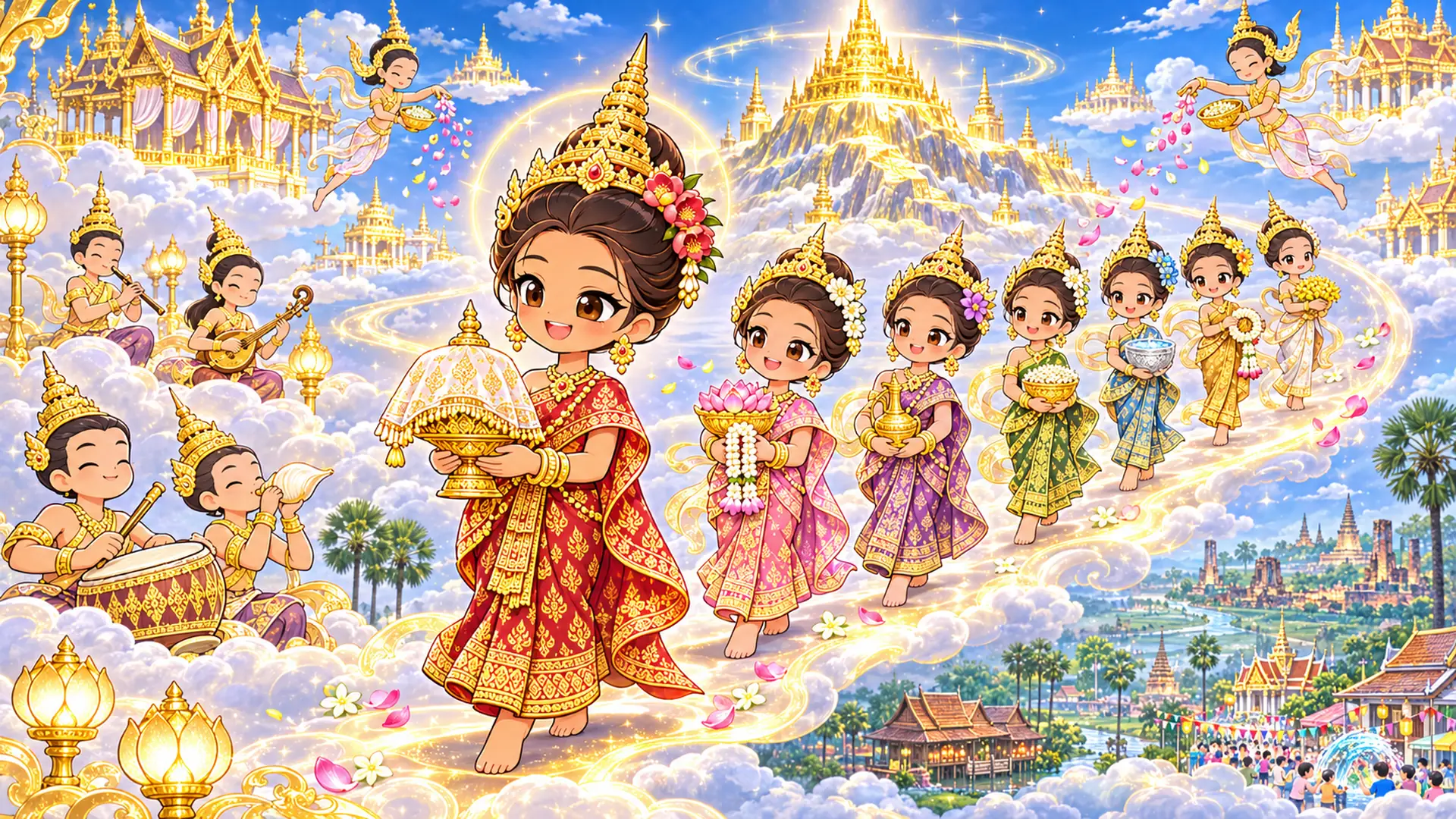
A heavenly procession circling the golden peak of Mount Meru among the clouds: Nang Songkran carrying the covered golden tray, her six sisters following, celestial musicians with drums and conch shells, flower petals falling; glorious.

Chapter

The Golden Procession

Every year, at the new year, one of the daughters carries the tray in a great procession around Mount Meru, the centre of the world. Then they lay it to rest in a crystal cave on Mount Krailat.
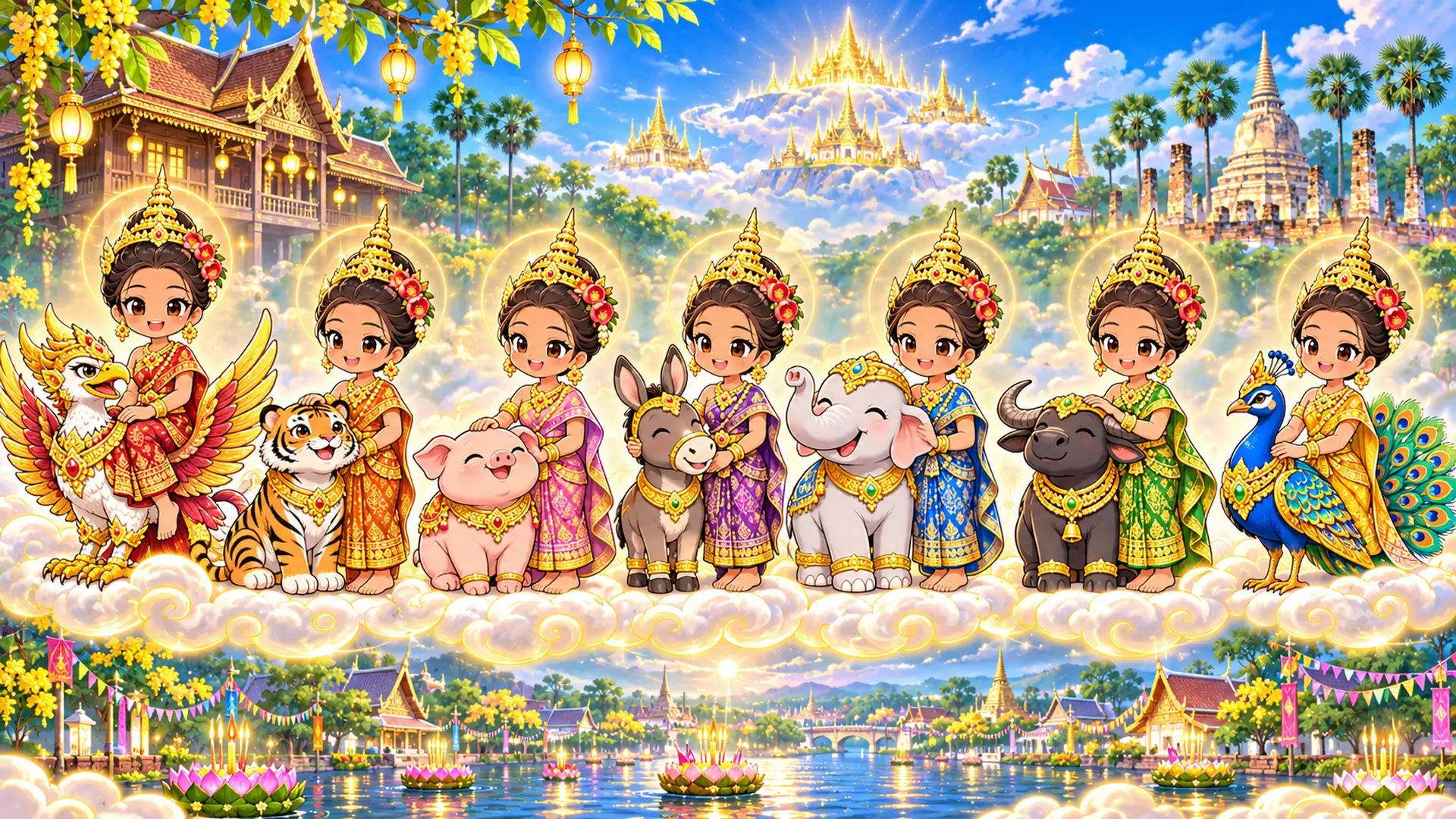
Seven goddess sisters standing in a row in the clouds, each beside her own animal mount, each in a different coloured silk. On the far left the eldest, Nang Songkran, rides a garuda; then her six sisters, one each with a tiger, a pig, a donkey, an elephant, a buffalo and a peacock. Colourful and magical.

The daughter whose turn it is becomes that year’s Nang Songkran — each riding her own animal: a garuda, a tiger, a peacock, an elephant…
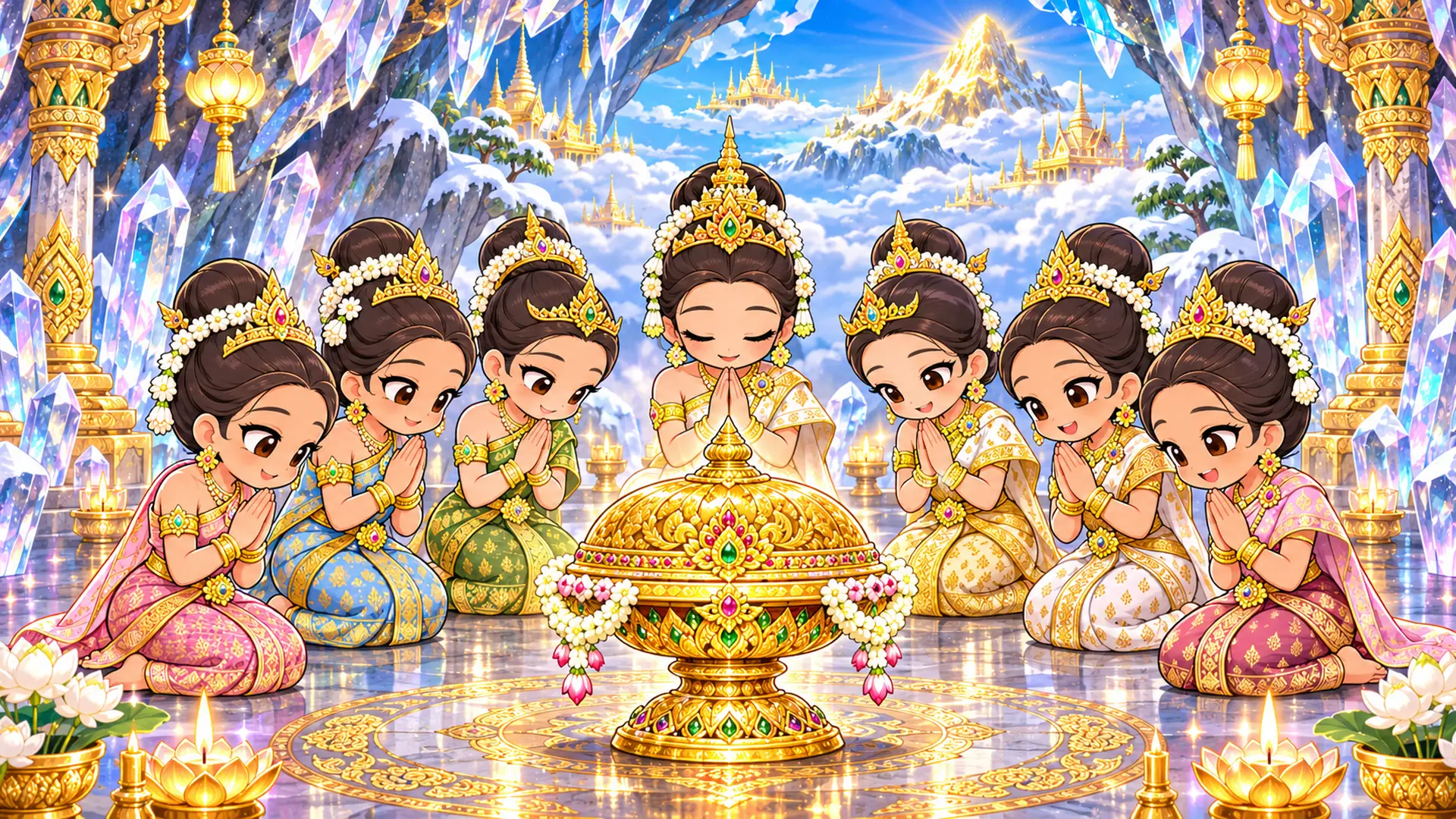
A crystal cave shrine on the snowy peak of Mount Krailat: the covered golden tray placed on a jewelled stand, the seven goddess sisters kneeling and bowing before it; serene and sacred.

And so the new year turns, and the god’s promise is kept, year after year.
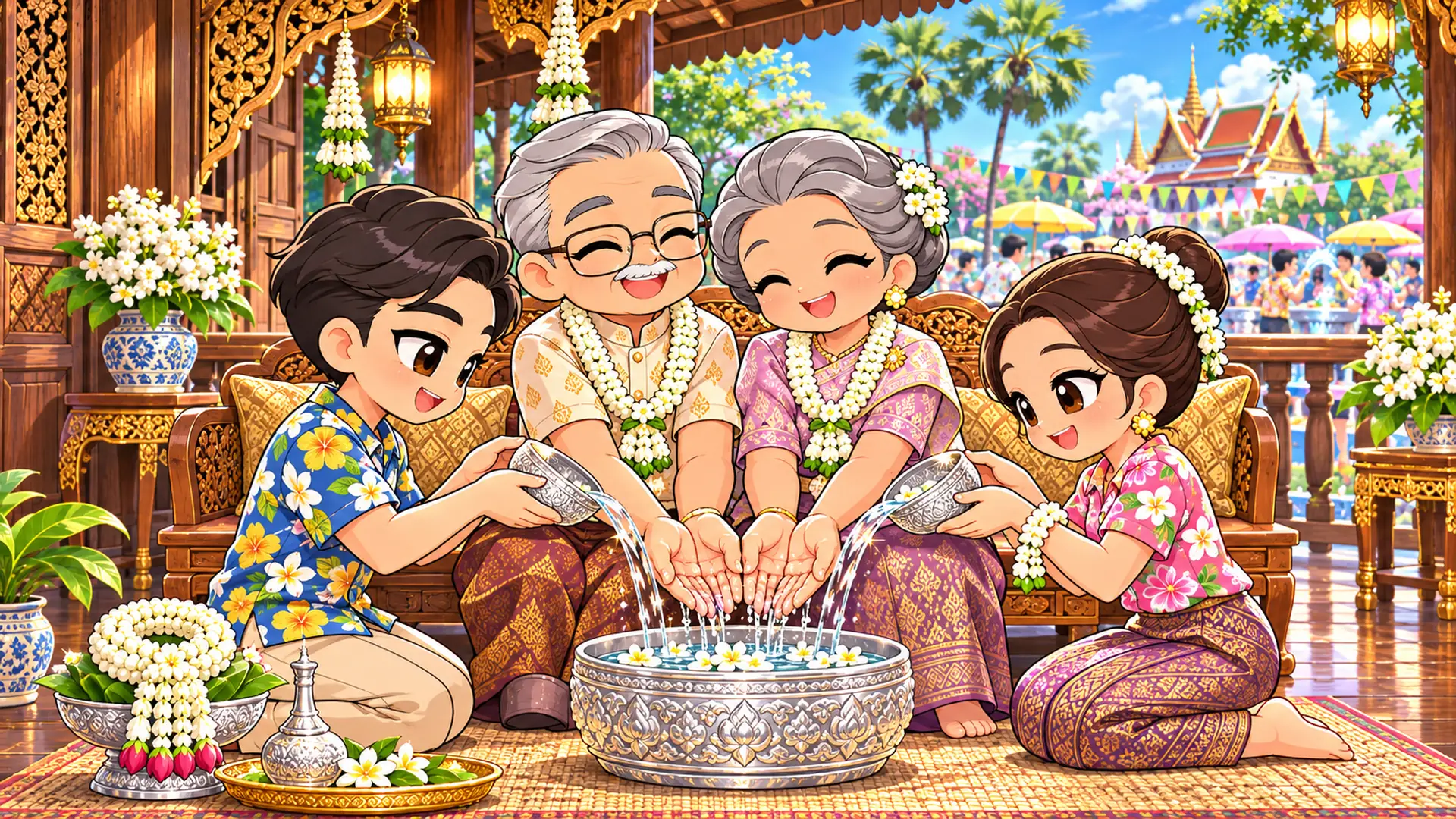
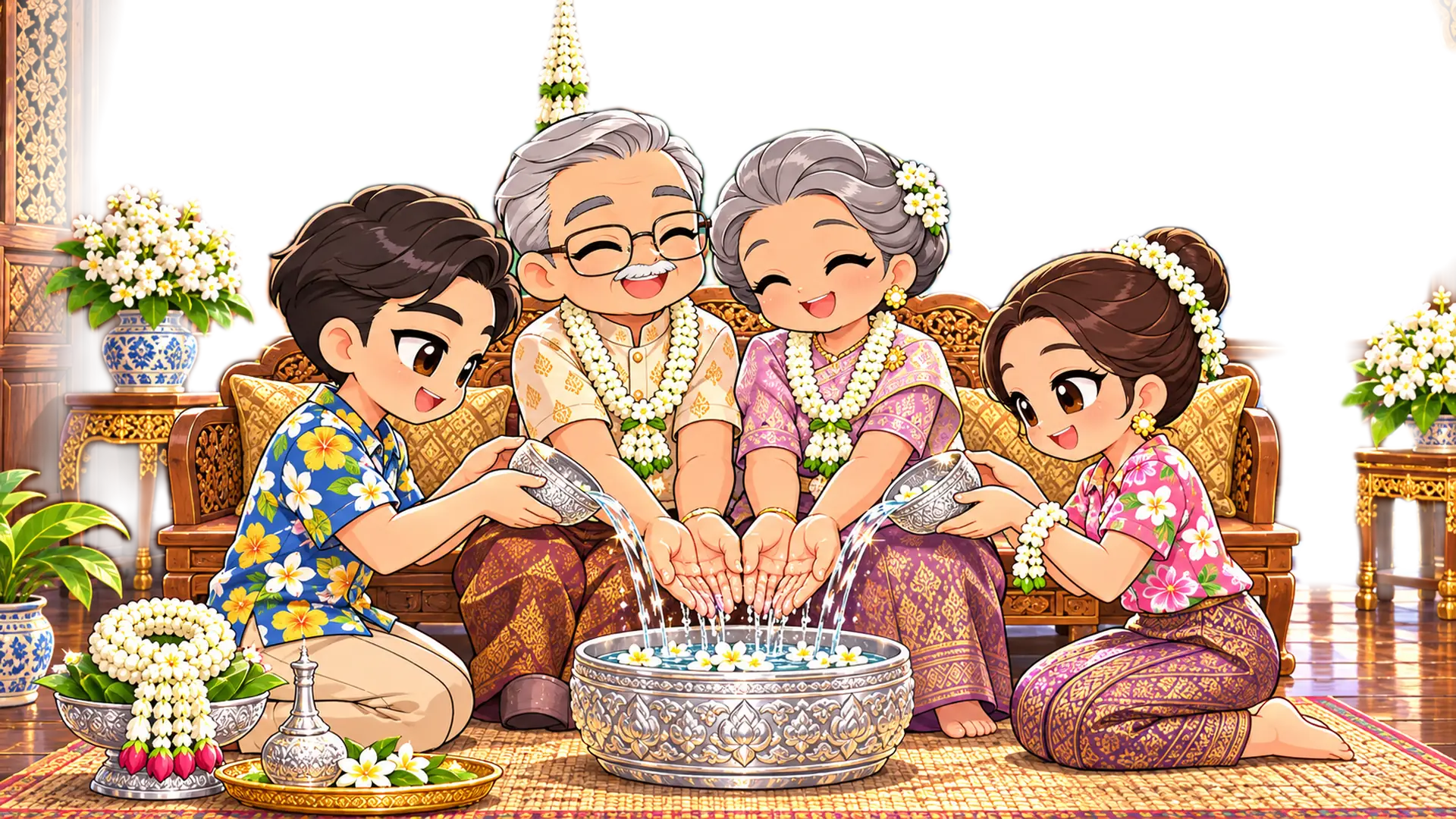
Present-day Songkran in a Thai home: young people in modern colourful shirts gently pouring jasmine-scented water from small silver bowls over the hands of smiling grandparents seated on a bench, garlands of jasmine; warm and respectful.

Chapter

Songkran Today

Today, Songkran is the Thai New Year, every April. It begins gently: young people pour fragrant water over the hands of their elders, and ask for their blessing.
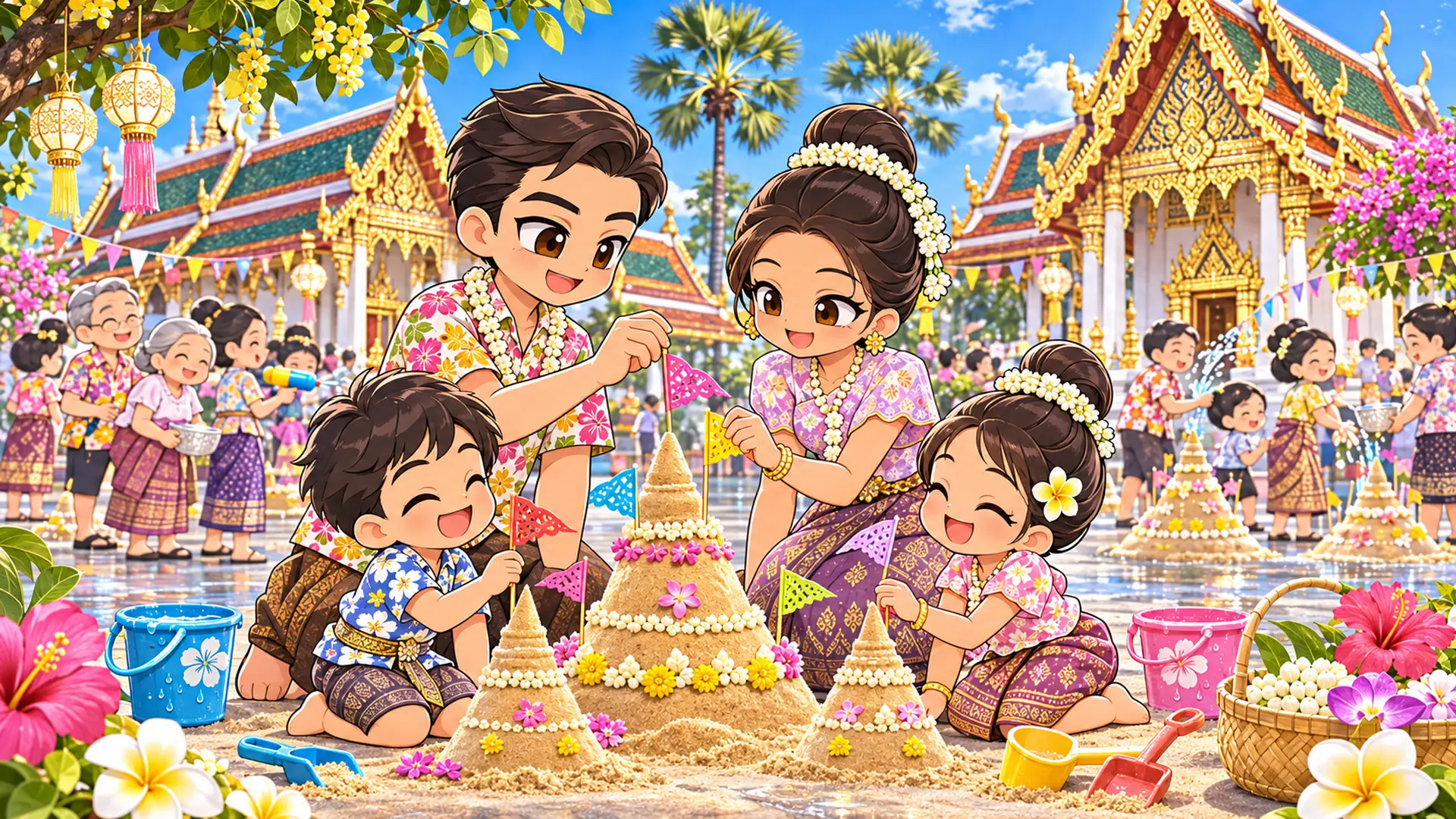
Present-day Songkran at a Thai temple courtyard: families building little sand chedis decorated with colourful paper flags, children laughing; temple roofs behind.

Families build little sand pagodas at the temples, and make merit for the new year.
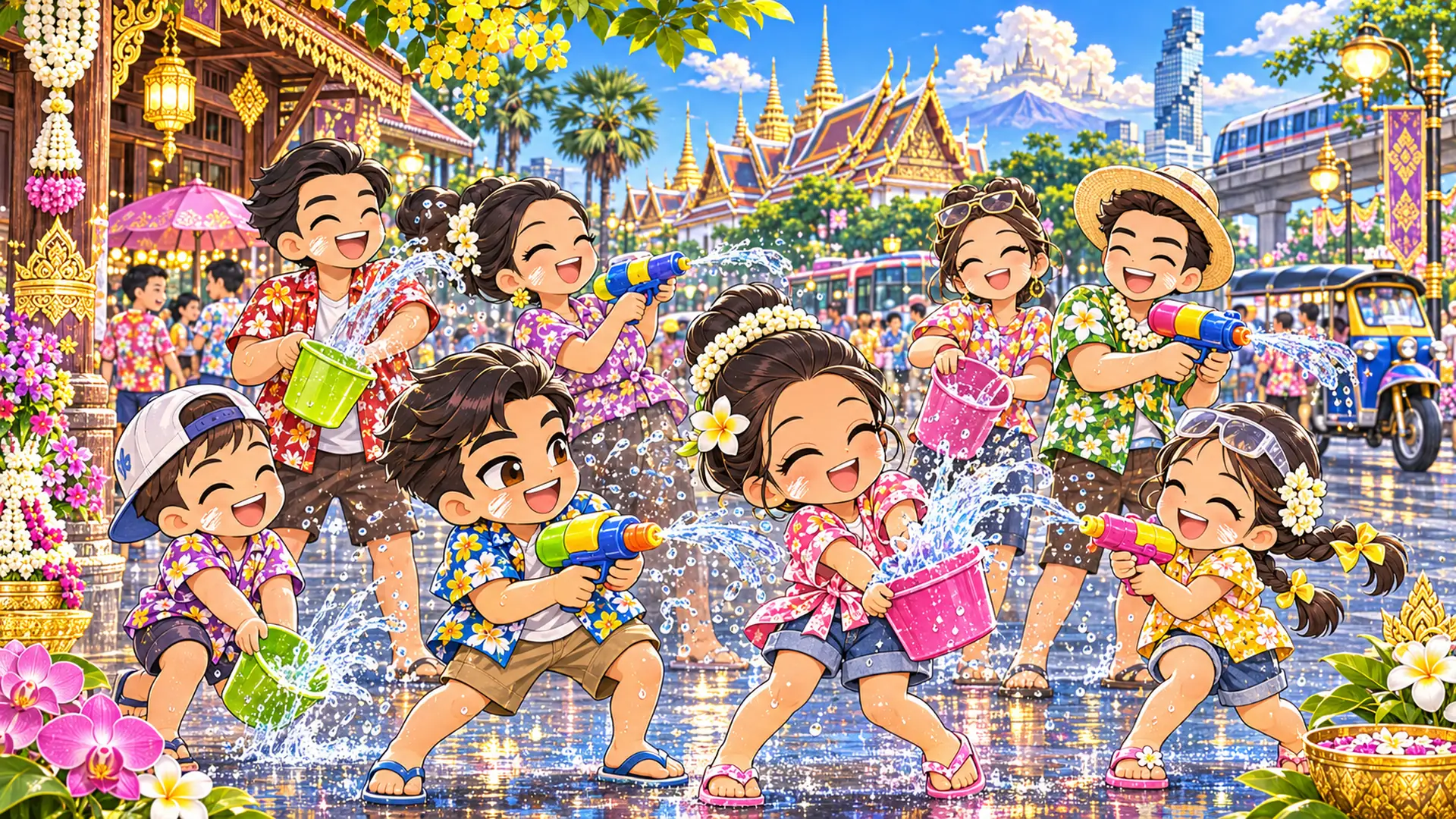
Present-day Songkran on a Bangkok street: joyful crowds in colourful floral shirts splashing water with buckets and water guns, laughing, sunshine and sparkling water droplets everywhere.

And then… everyone gets soaked. Songkran is the biggest water fight on earth — in 2023, UNESCO even listed it as world heritage.
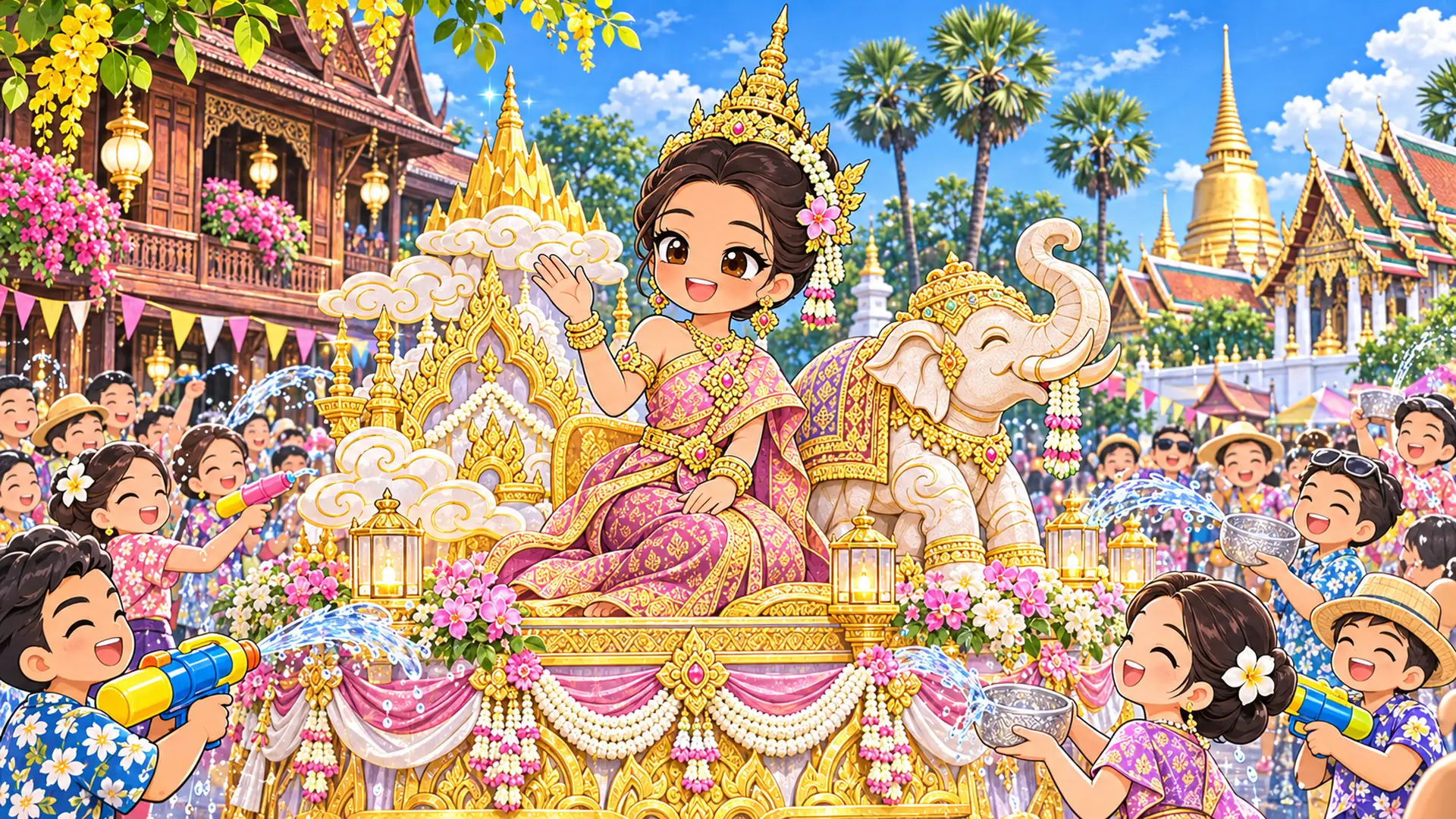
Present-day Songkran parade in a Thai town: a young woman dressed as Nang Songkran in sparkling gold and silk, crowned, sitting on a decorated float beside a statue of her animal mount, crowds cheering and splashing water.

And every year, a Nang Songkran is announced — the goddess carrying the tray, with her animal and her prediction for the year ahead.

So next time you’re splashed at Songkran, remember: it started with a boy who listened to the birds.