Skip to story
อ่านเป็นภาษาไทย
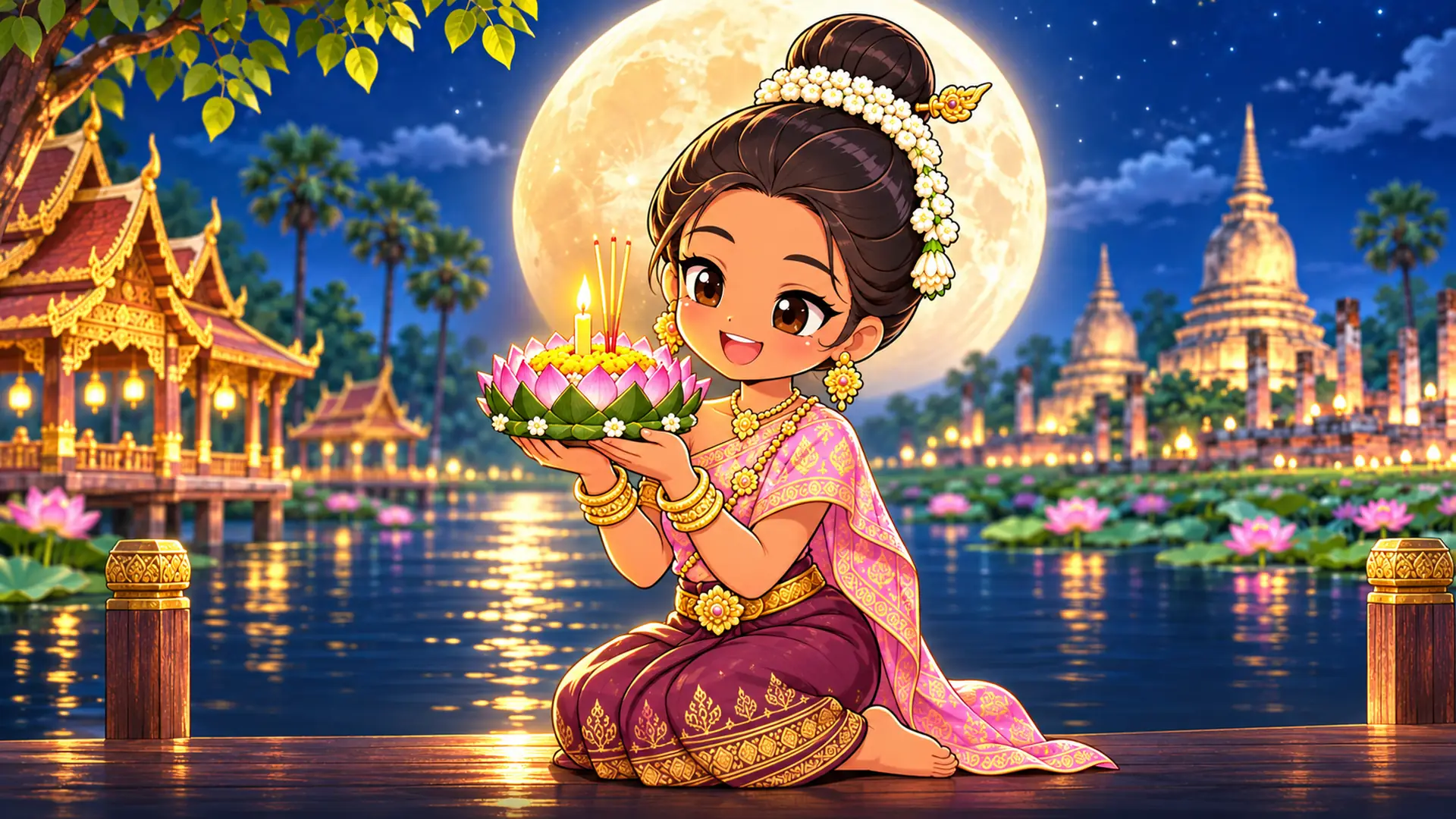
Nang Noppamas holding the glowing lotus-shaped krathong close to her face above dark water, the candle light warm on her face, a huge full moon behind her, her face large and clearly lit, gentle smile.

Thai Festival Legend · 3 min read

Loy Krathong

ลอยกระทง

On the twelfth full moon in Sukhothai, every lady of the court brought the king a dazzling lantern. Nang Noppamas folded a simple lotus from banana leaves — and started Thailand's festival of floating lights.

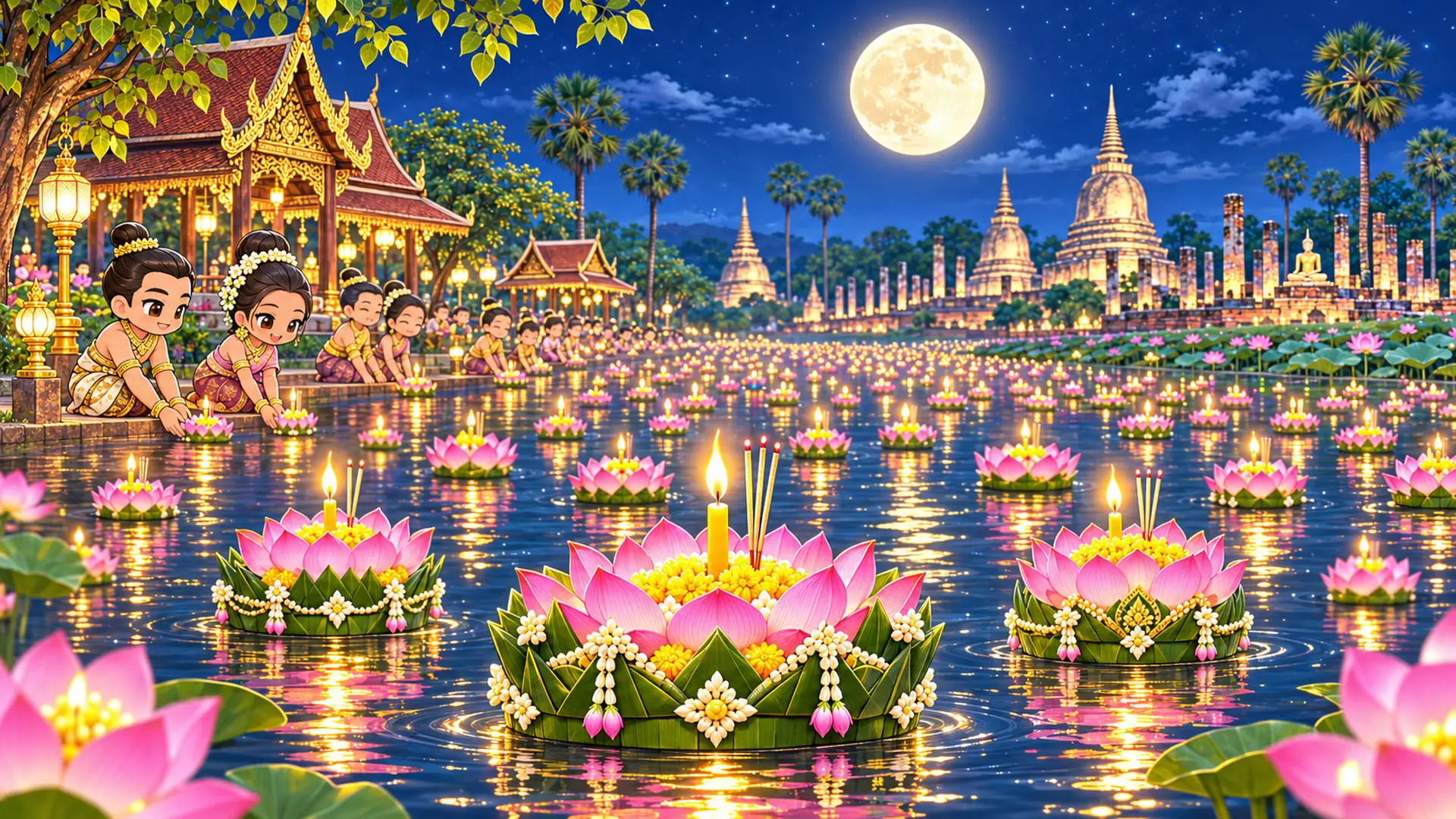
Present-day Thailand, full-moon night: a wide calm river covered with thousands of small glowing lotus-shaped krathong floats made of banana leaves and flowers, each with a tiny candle flame, drifting toward the camera, a huge full moon above, people kneeling at the riverbank in the soft distance, magical and serene, the krathongs crisp in the foreground.

Chapter

A River of Lights

Tonight, on rivers, canals and ponds all over Thailand, millions of tiny boats are set on the water. Each one carries a candle, a flower… and a wish. They are called krathongs, and the festival is Loy Krathong — “loy” means to float. According to legend, the very first one was made by a girl… from a single lotus.
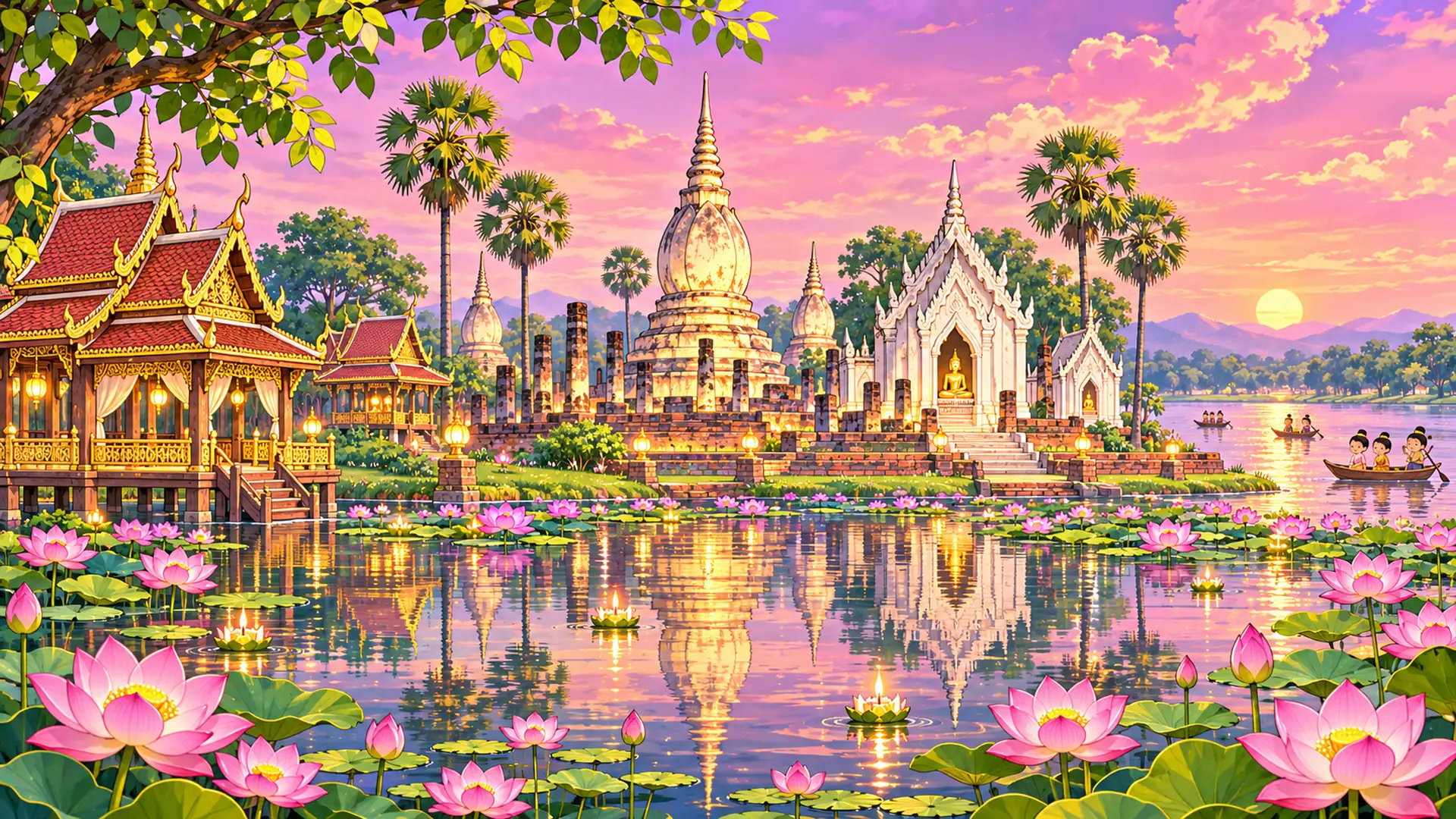
Establishing shot of ancient Sukhothai at dusk: slender lotus-bud-shaped chedis and white stucco temples reflected in a wide still pond full of lotus, wooden palace pavilions with tiered red-and-gold roofs, sugar palms, a few people in boats, pink and gold sky; only tiny distant villagers in boats.

Chapter

The Kingdom of Sukhothai

Seven hundred years ago, there was a kingdom called Sukhothai — “the dawn of happiness” — often called the first great Thai kingdom. A city of wide, still ponds, crowned with temples shaped like lotus buds.
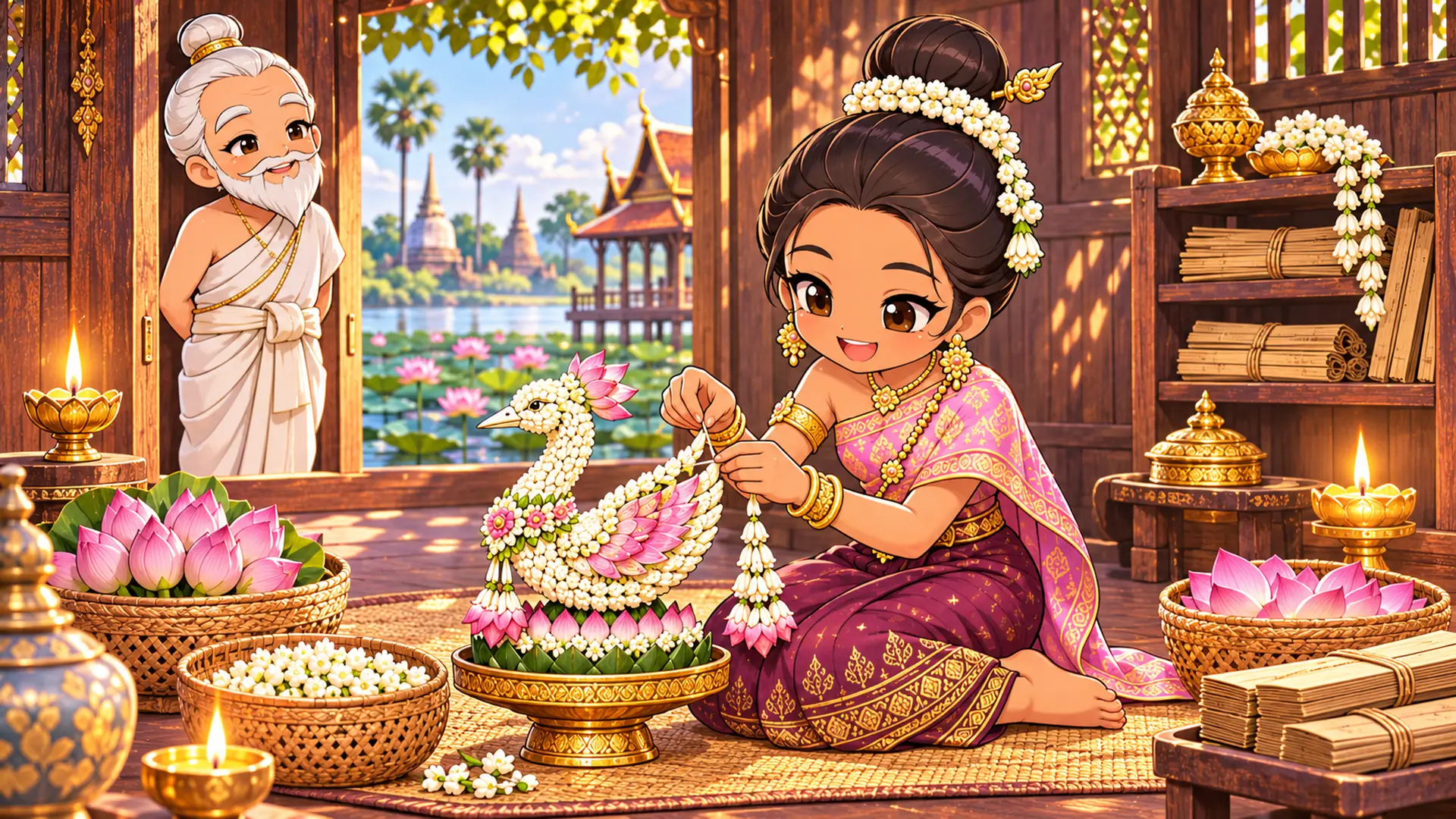
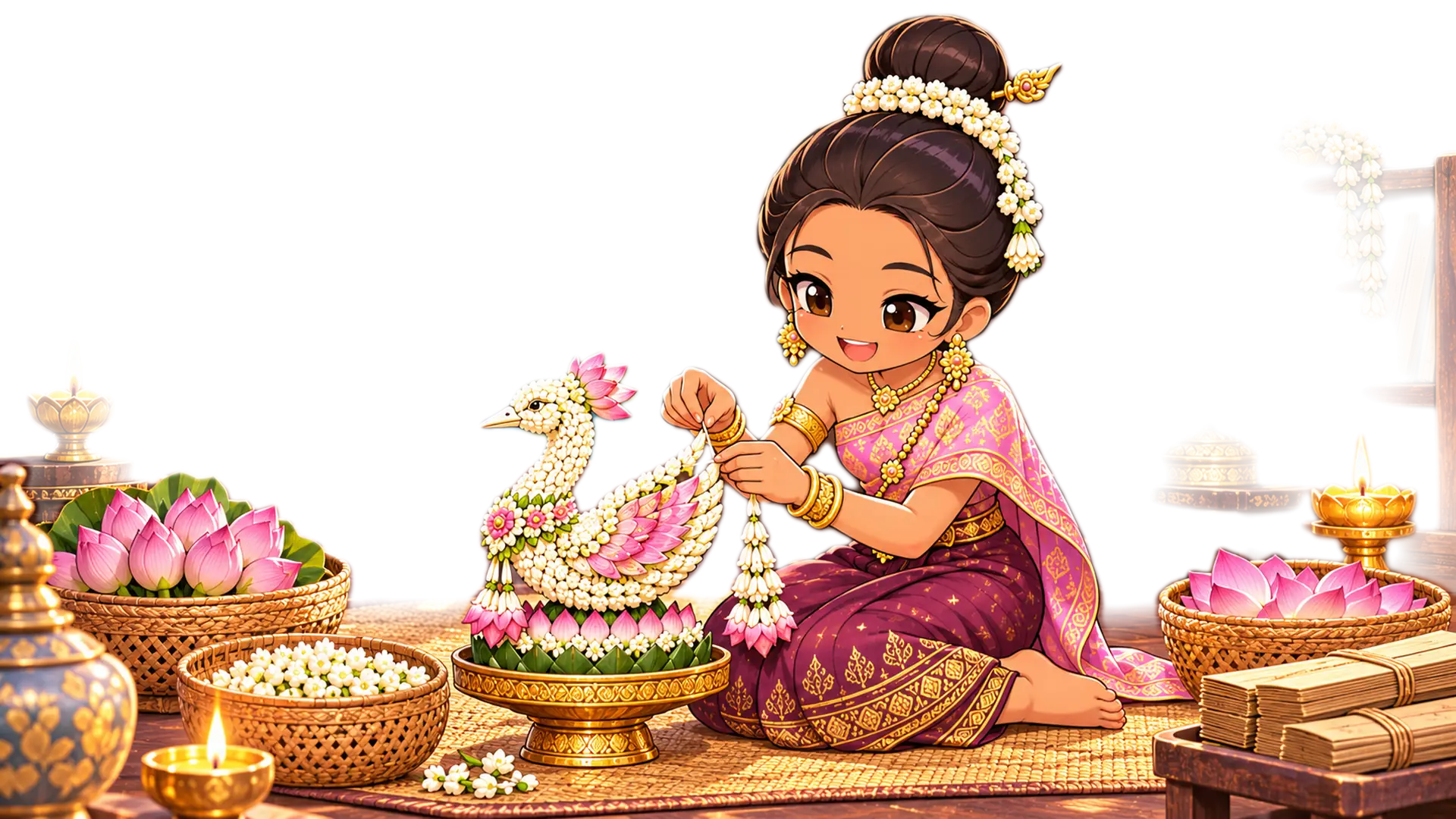
Inside a Brahmin priest's wooden house in Sukhothai, warm afternoon light: young Nang Noppamas sitting on a woven mat weaving jasmine and lotus flowers into an intricate garland shaped like a bird, baskets of flowers and palm-leaf manuscripts around her, her father Sri Mahosot watching proudly from the doorway.

Chapter

Nang Noppamas

There lived a girl named Noppamas, the daughter of a Brahmin priest of the royal court. The story goes that she was not only beautiful. She was brilliant. She could read and write, compose verses, and weave flowers into shapes so delicate that people stopped in the street to look.
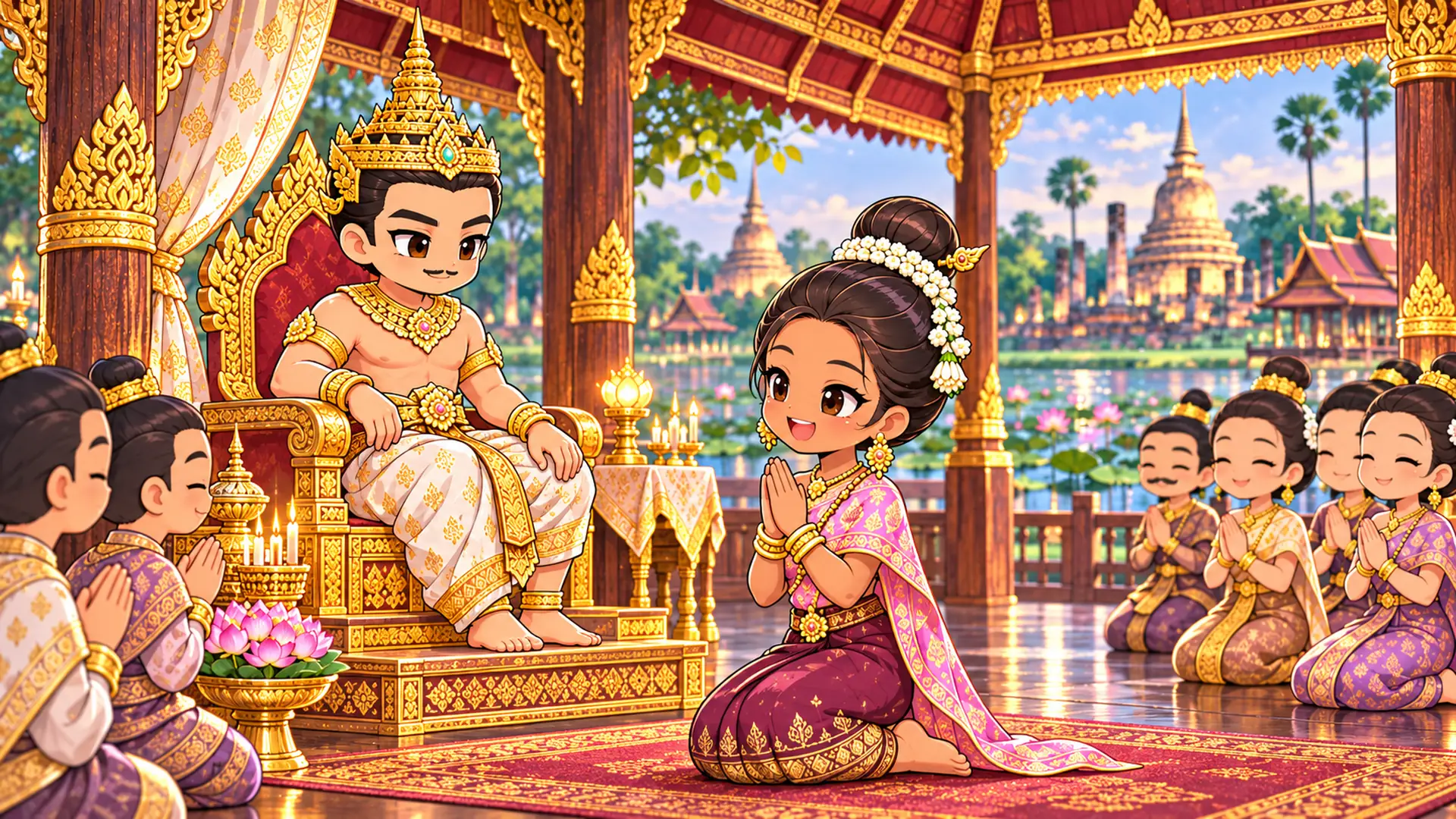
A royal audience pavilion with tiered red-and-gold roof and carved teak pillars: Nang Noppamas kneeling gracefully with hands pressed together in a respectful wai, presented to King Phra Ruang of Sukhothai seated on a raised throne, courtiers kneeling on both sides, golden afternoon light.

Word of her reached the king, Phra Ruang. Noppamas was brought to the palace, and became one of his consorts… and soon, his favourite.
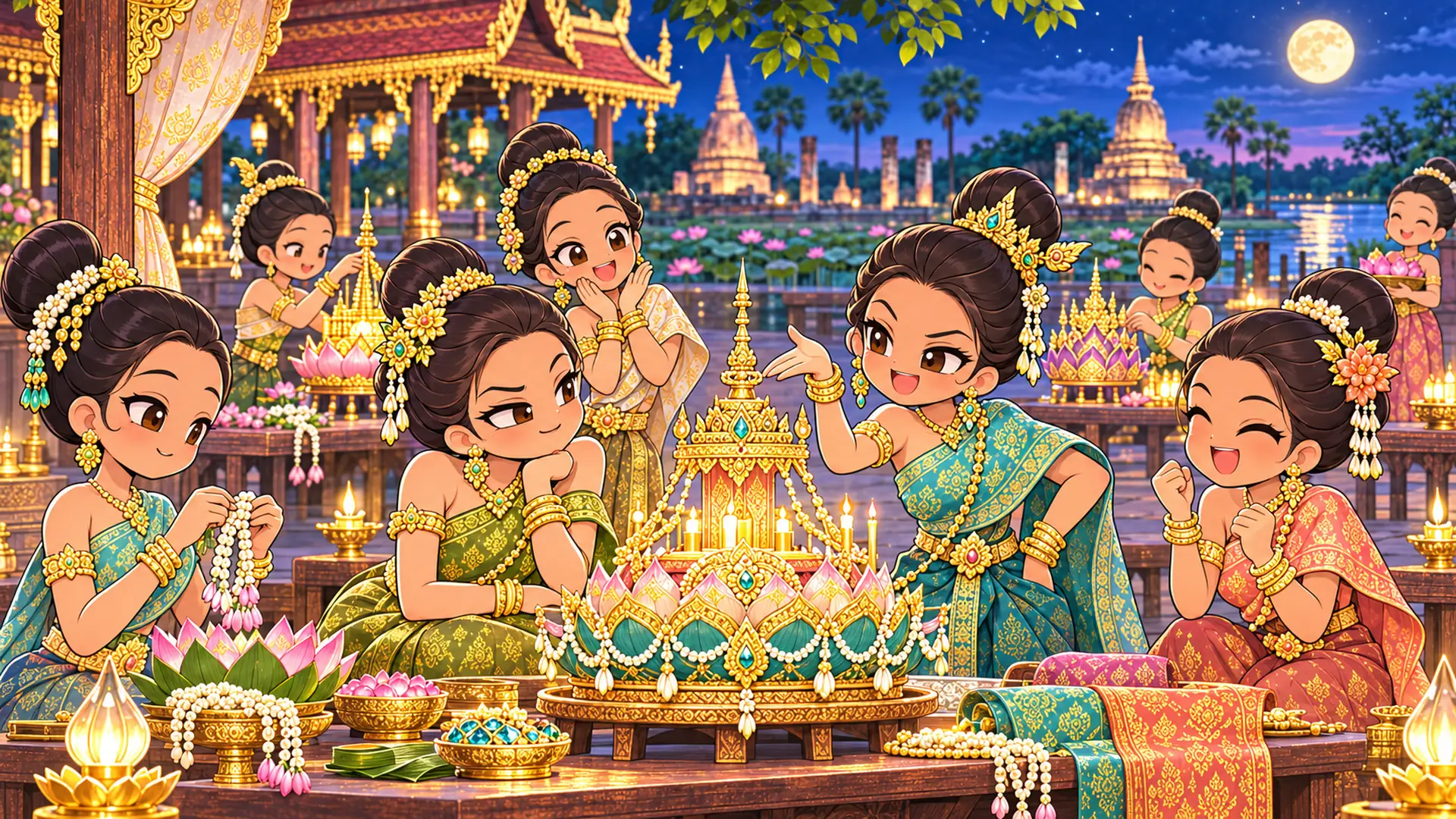
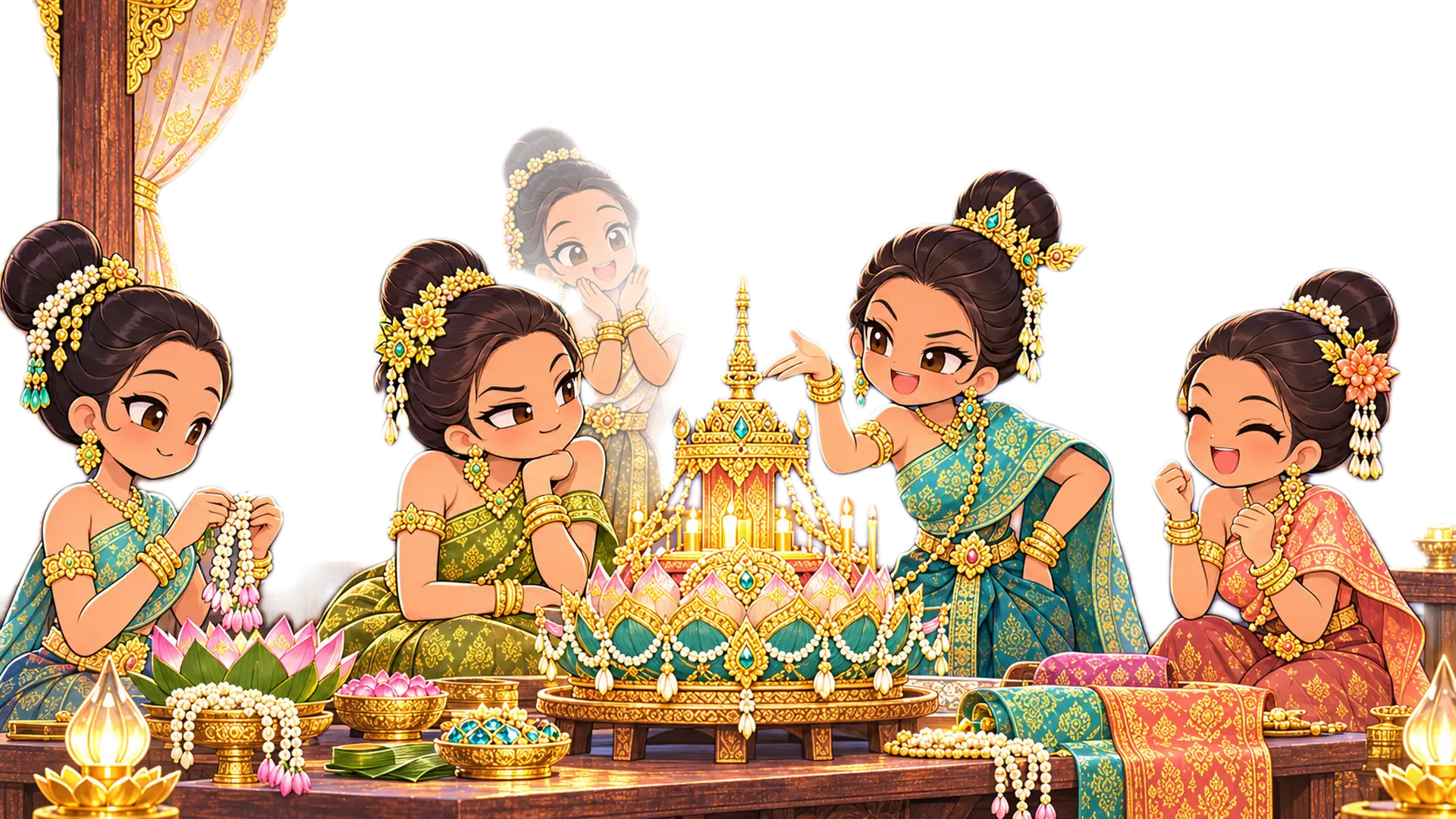
A palace courtyard on the evening before the festival: elegant palace ladies busy making splendid lantern-floats — gilded, wrapped in silk, studded with glittering jewels, competing and admiring each other's work, lamps being lit, a sense of rivalry and excitement; Nang Noppamas is not among them.

Chapter

The Twelfth Full Moon

Every year, on the full moon of the twelfth month, when the rivers run high after the rains, the court held a festival of lights on the water. And every lady of the palace tried to outshine the others. Lanterns of gold. Lanterns of silk. Lanterns studded with jewels.
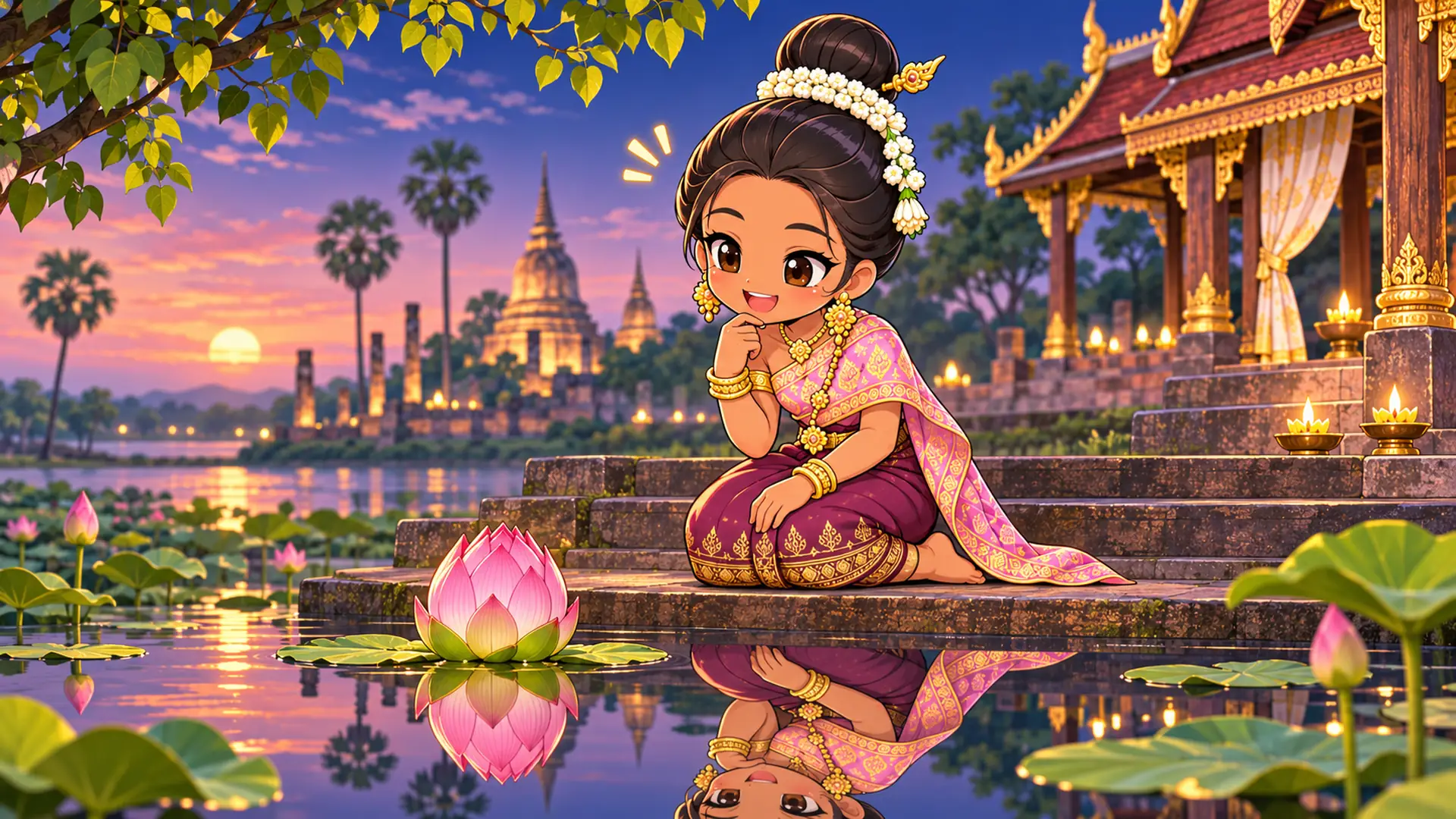
A quiet lotus pond at dusk at the edge of the palace grounds: Nang Noppamas alone, kneeling on the stone steps at the water, gazing at a large pink lotus flower about to close for the night, its reflection in the still water, lotus-bud chedis silhouetted in the distance, a gentle idea dawning on her face.

Noppamas went somewhere else. To the lotus pond, at dusk. She watched the flowers close for the night… and an idea opened.
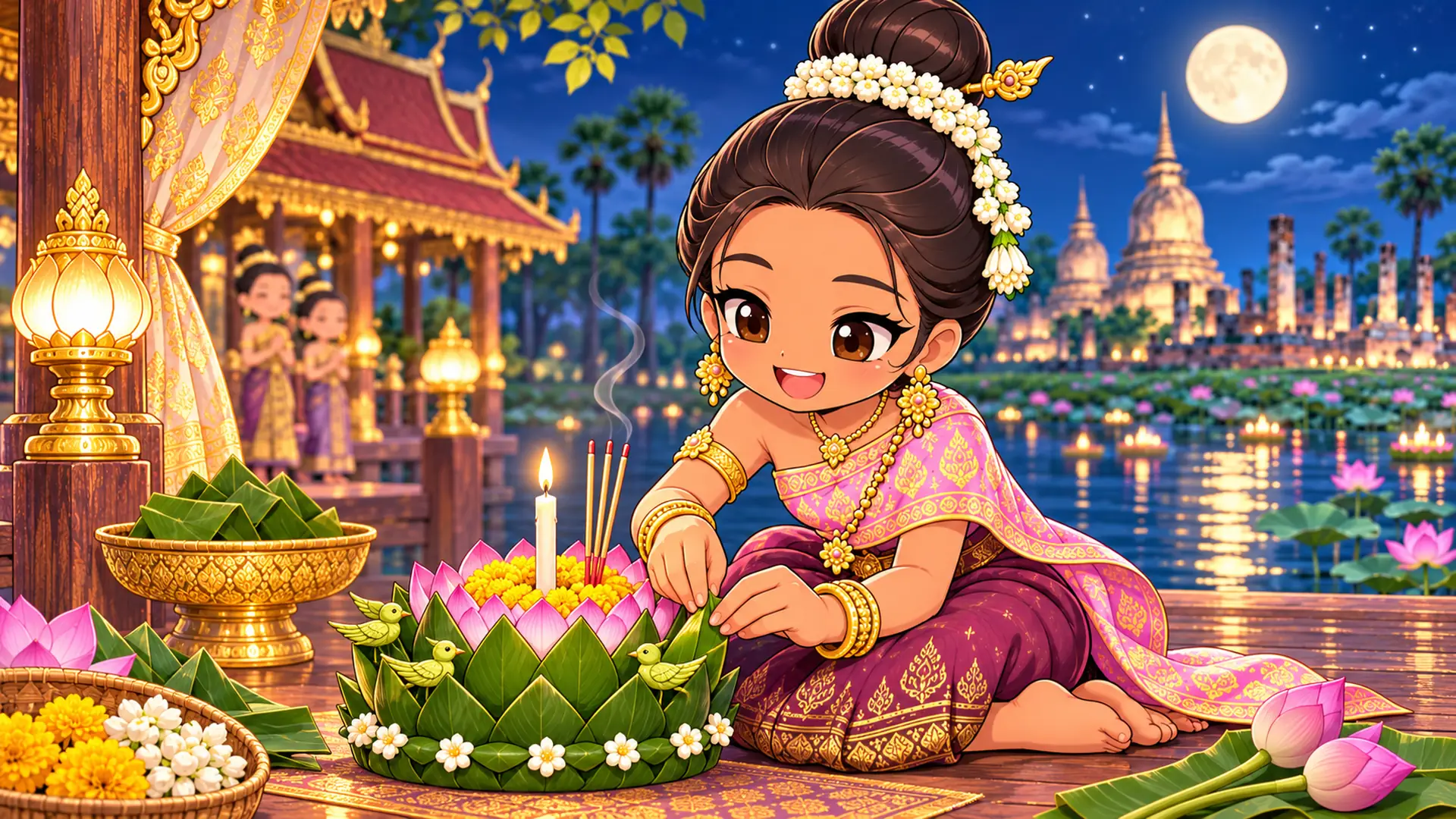
Close-up of Nang Noppamas's hands folding fresh green banana leaves into pointed petals and shaping them into a lotus-shaped float, a white candle and three incense sticks being placed in its heart, marigolds and jasmine, tiny carved birds perched on the petals, warm lamplight, her face softly visible above.

She folded banana leaves into petals, and shaped them into a lotus in full bloom. In its heart she set a candle, incense and flowers — and tiny birds, perched on its petals.
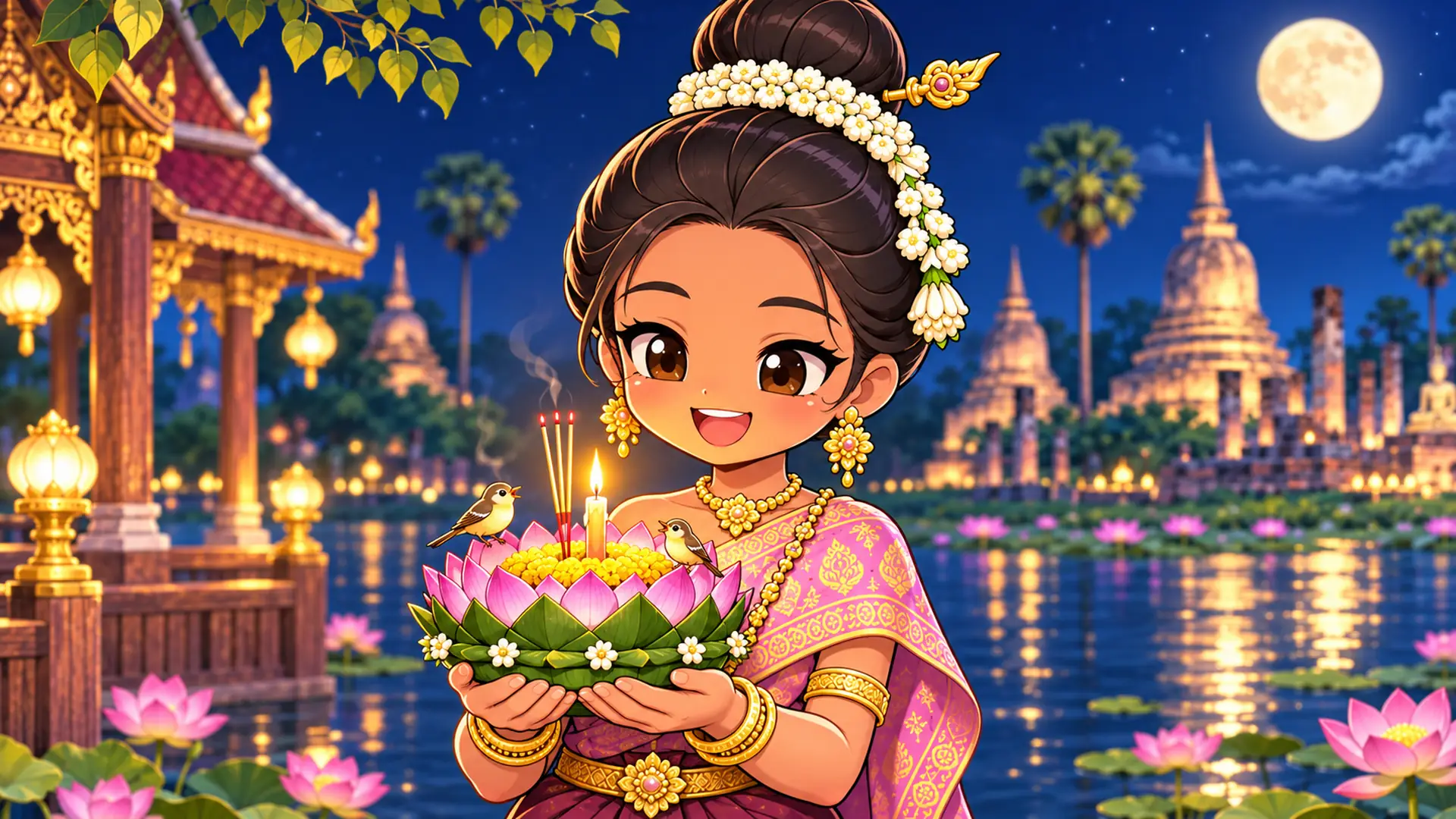
The finished krathong: a beautiful lotus-shaped float of folded banana leaves and pink lotus petals with a lit candle, incense, flowers and tiny birds on its petals, held carefully in Nang Noppamas's hands, the candle glow lighting her serene face from below, dark background.

It was not the richest float that night. But it was the most beautiful.
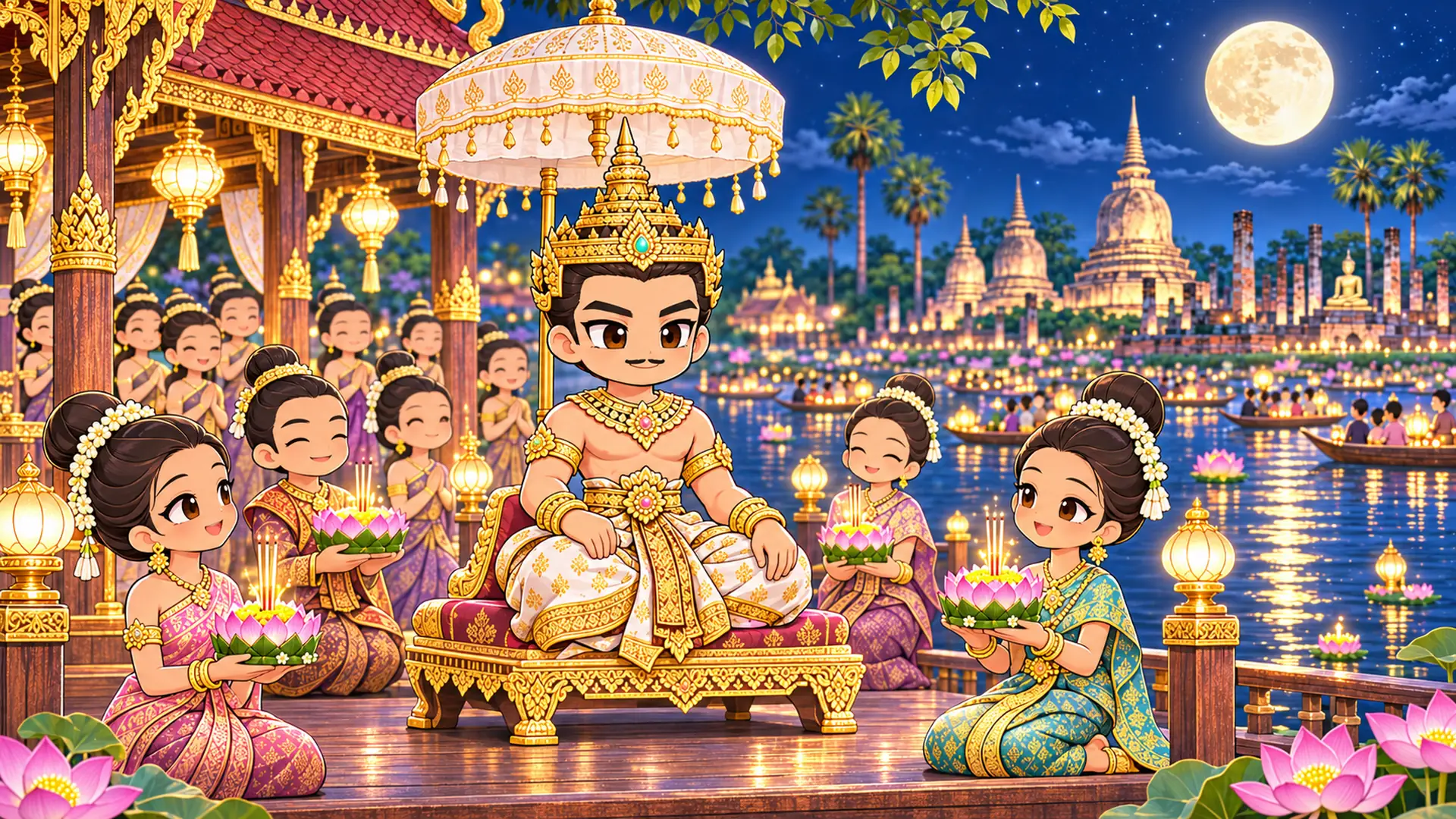
Full-moon night festival on the wide river beside Sukhothai: a royal landing pier with tiered pavilion roofs hung with lamps, King Phra Ruang of Sukhothai seated under a white parasol, courtiers and palace ladies holding their glittering lantern-floats, crowds and boats with lamps on the water, the full moon rising, festive and magical.

Chapter

The Lotus on the Water

Under the full moon, the whole court gathered at the water’s edge.
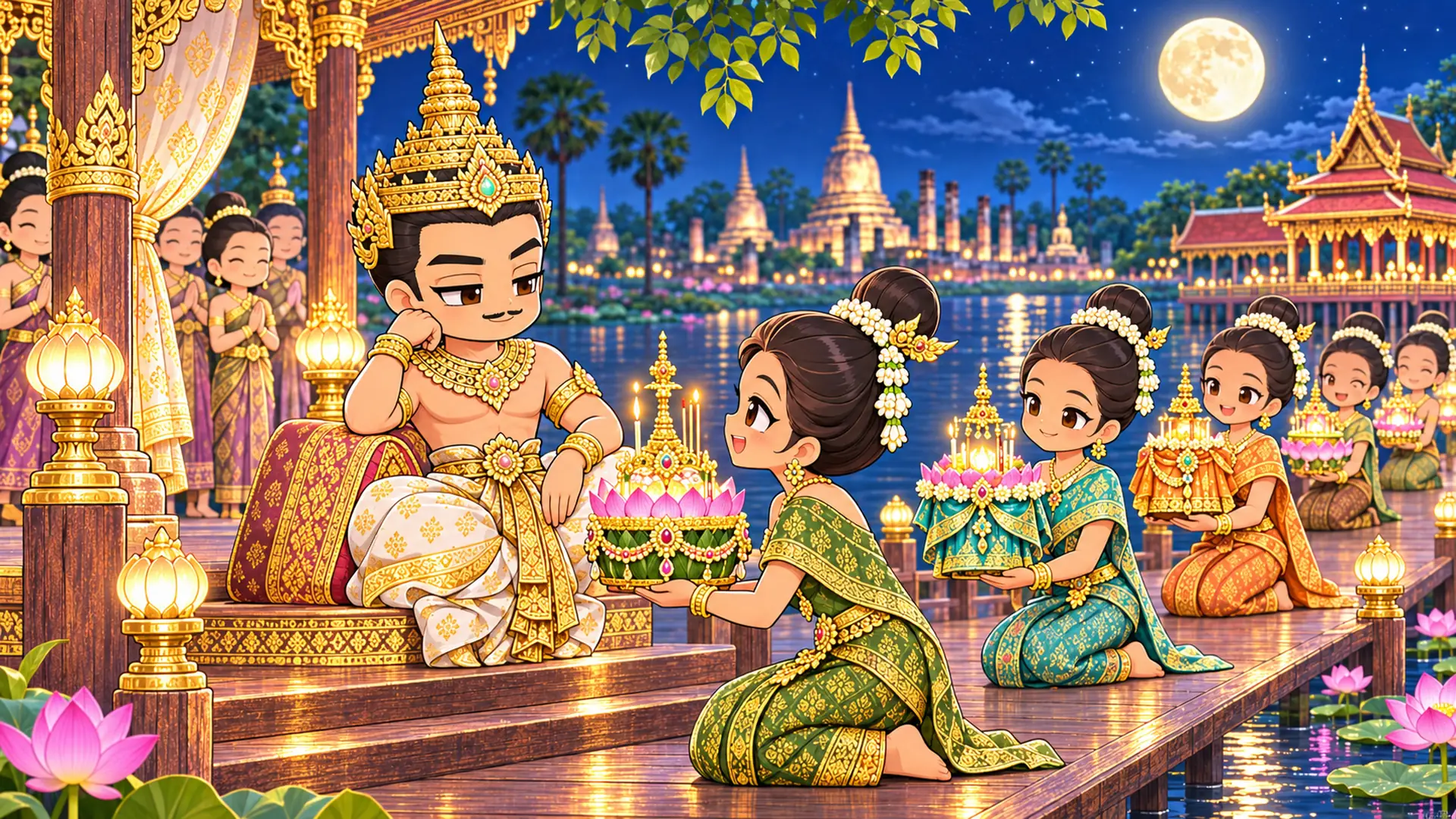
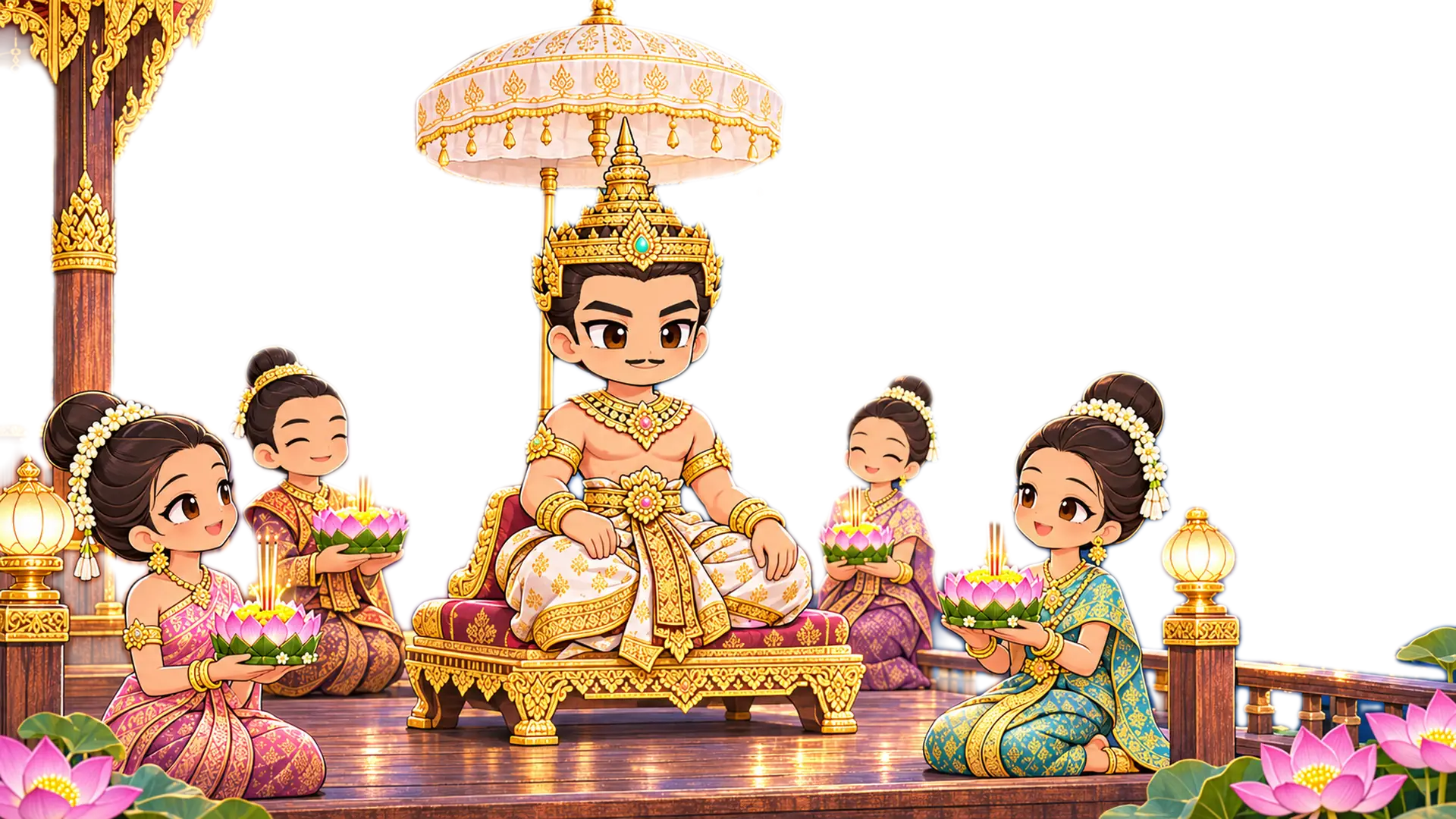
At the royal pier under the full moon: palace ladies kneeling one after another to present gilded, jewelled, silk-wrapped lantern-floats to King Phra Ruang of Sukhothai, who smiles politely but looks unmoved, lamplight glinting on gold; the king's face polite but bored.

One by one, the ladies presented their lanterns to the king. He smiled politely. Gold. Silk. Jewels.
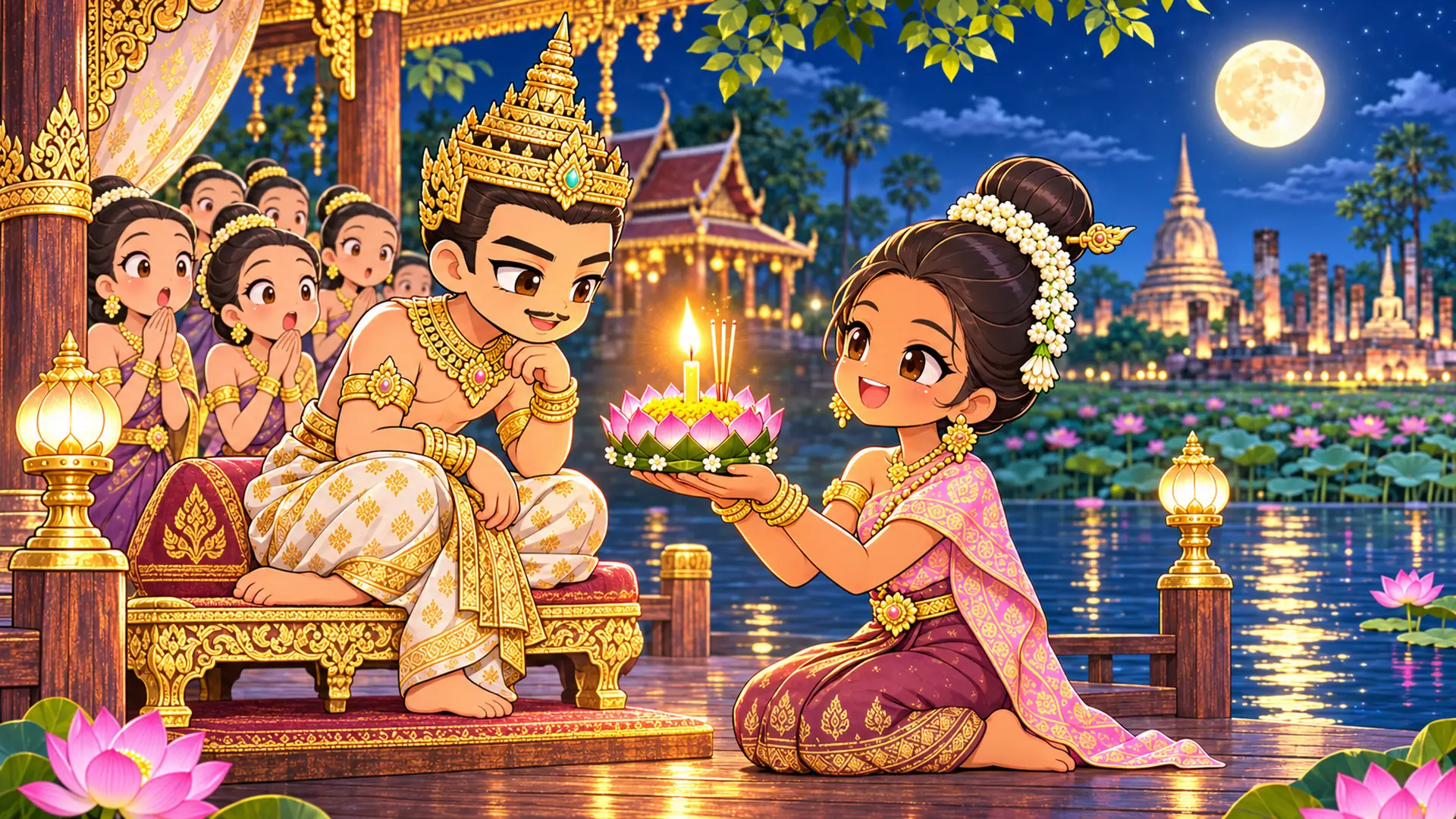
At the royal pier under the full moon: Nang Noppamas kneeling and offering her simple glowing lotus-shaped krathong with both hands, King Phra Ruang of Sukhothai leaning forward from his seat, intrigued and captivated, the other ladies watching in surprise, the candle flame the brightest light in the frame.

Then Noppamas knelt, and offered her lotus. The king leaned forward. “Why a lotus?” he asked.
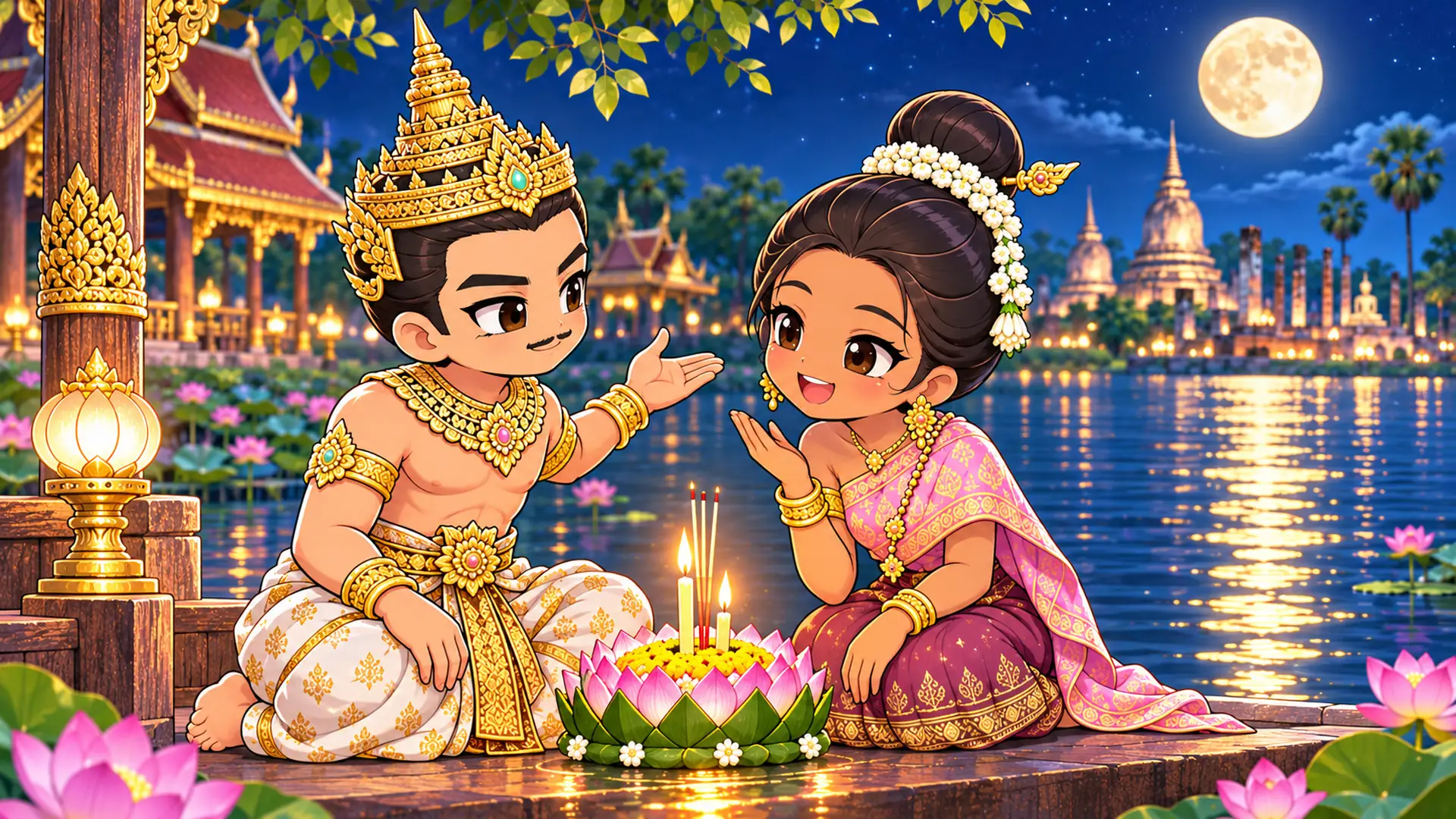
Close two-shot at the water's edge at night: Nang Noppamas speaking softly to King Phra Ruang of Sukhothai, gesturing gently toward the river and the full moon, the lotus krathong glowing between them, the king listening thoughtfully, intimate and warm.

In the old telling, she answered that the lotus is the flower of the Buddha — it rises from the mud and opens clean and pure. Let it carry their respect down the river… and their thanks to the Mother of Waters.
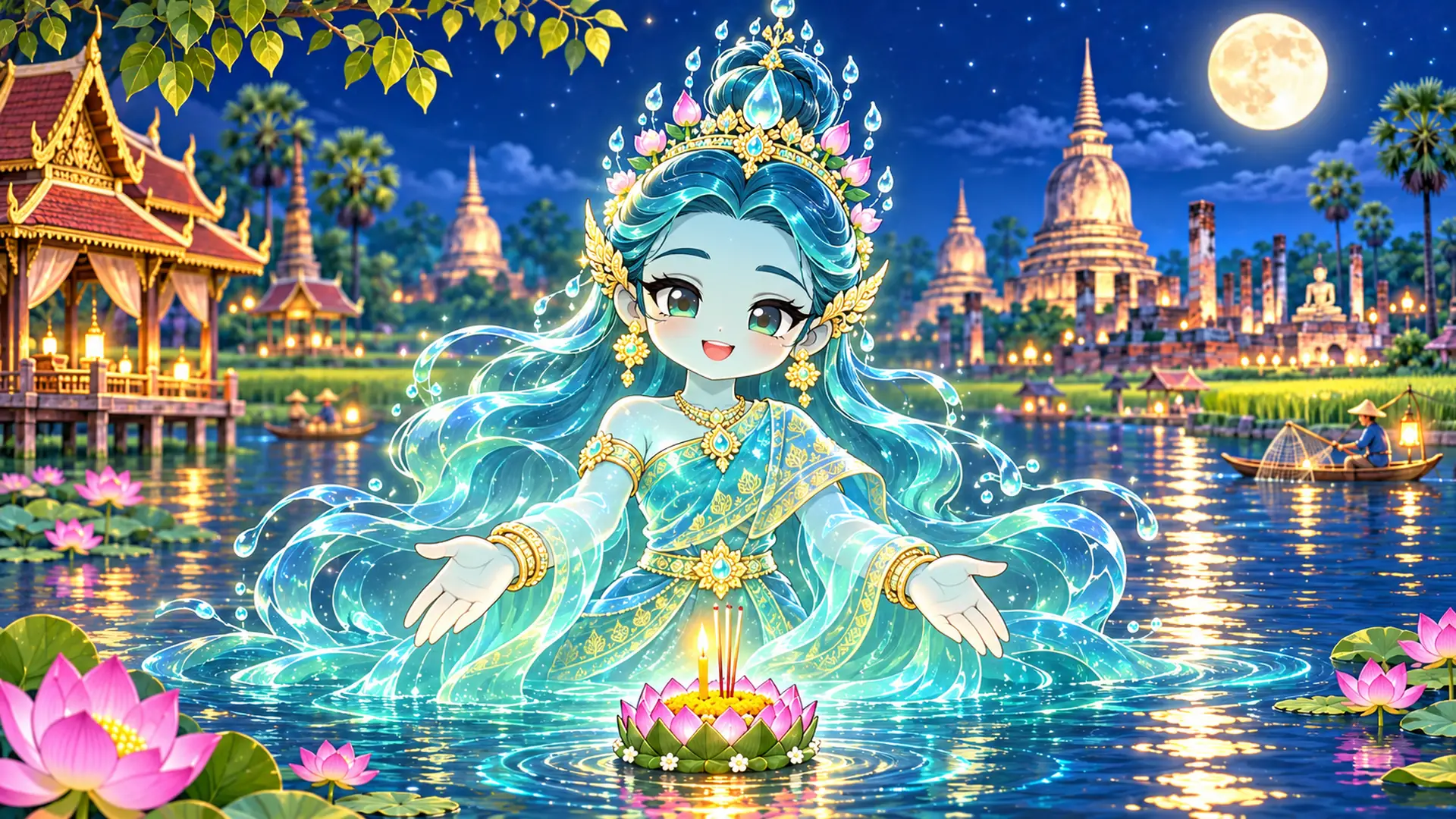
Mythic vision: rising softly from the moonlit river, Phra Mae Khongkha, the Mother of Waters — a serene, motherly river goddess clearly older and different from Noppamas, translucent body made of flowing water and light, long hair flowing into the river current, robes of shimmering blue-green water, a tall crown of water droplets and tiny lotus buds, glowing pale aqua skin, open welcoming hands; a single lotus krathong floating before her, rice fields and fishing boats faint on the banks, reverent and luminous.

For the river gave the people everything: rice, fish, the water they drank. All year they took from it, and spoiled it. So once a year, they would thank the river goddess, Phra Mae Khongkha — and ask her forgiveness.
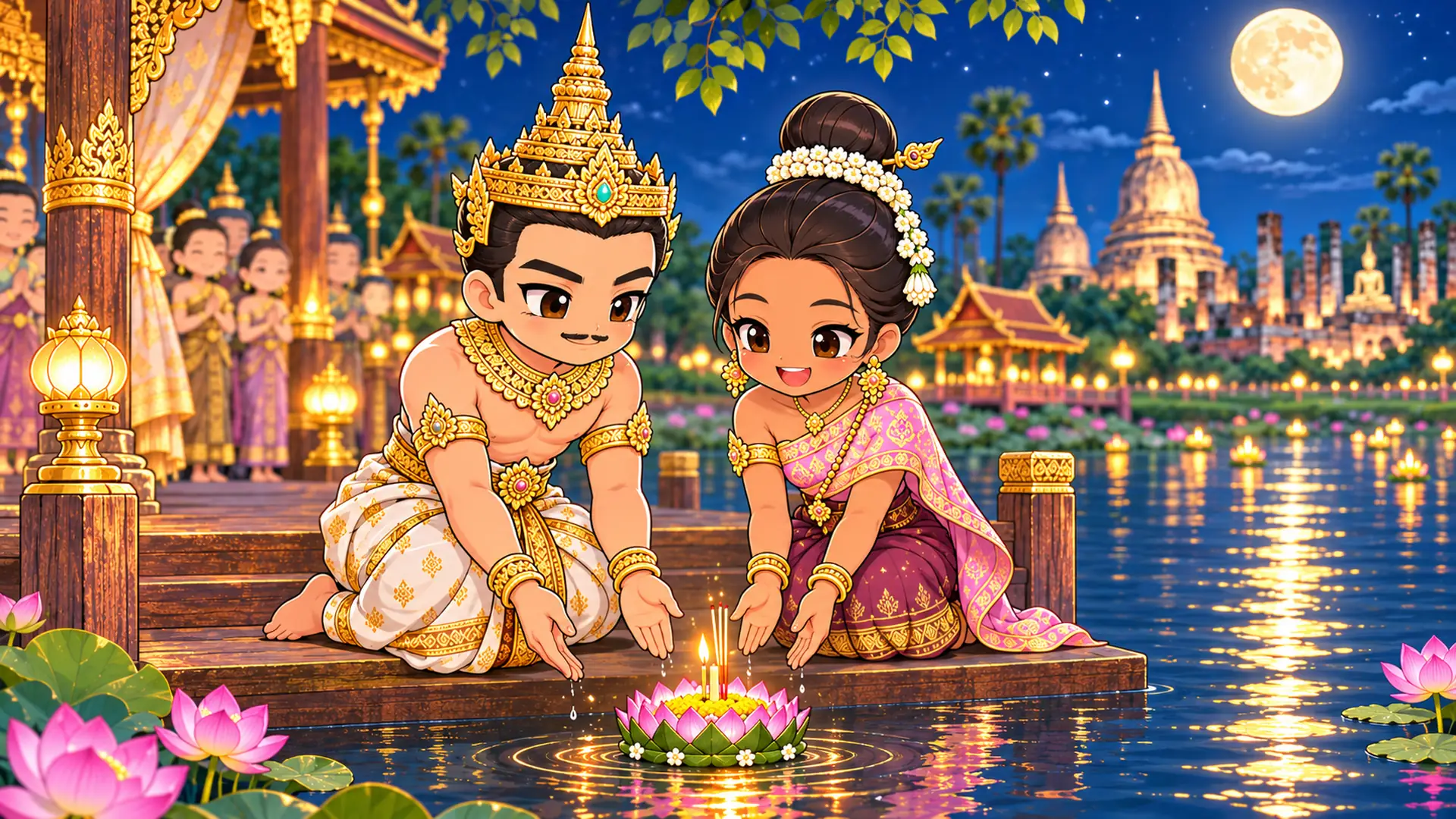
The climax: King Phra Ruang of Sukhothai and Nang Noppamas kneeling together on the lowest step of the royal pier, gently setting the glowing lotus-shaped krathong onto the dark river, their hands releasing it, the full moon reflected in the water beside it, courtiers and lamps softly blurred behind them.

The king was moved. Together, they knelt by the water, set the lotus on the river… and let it go.
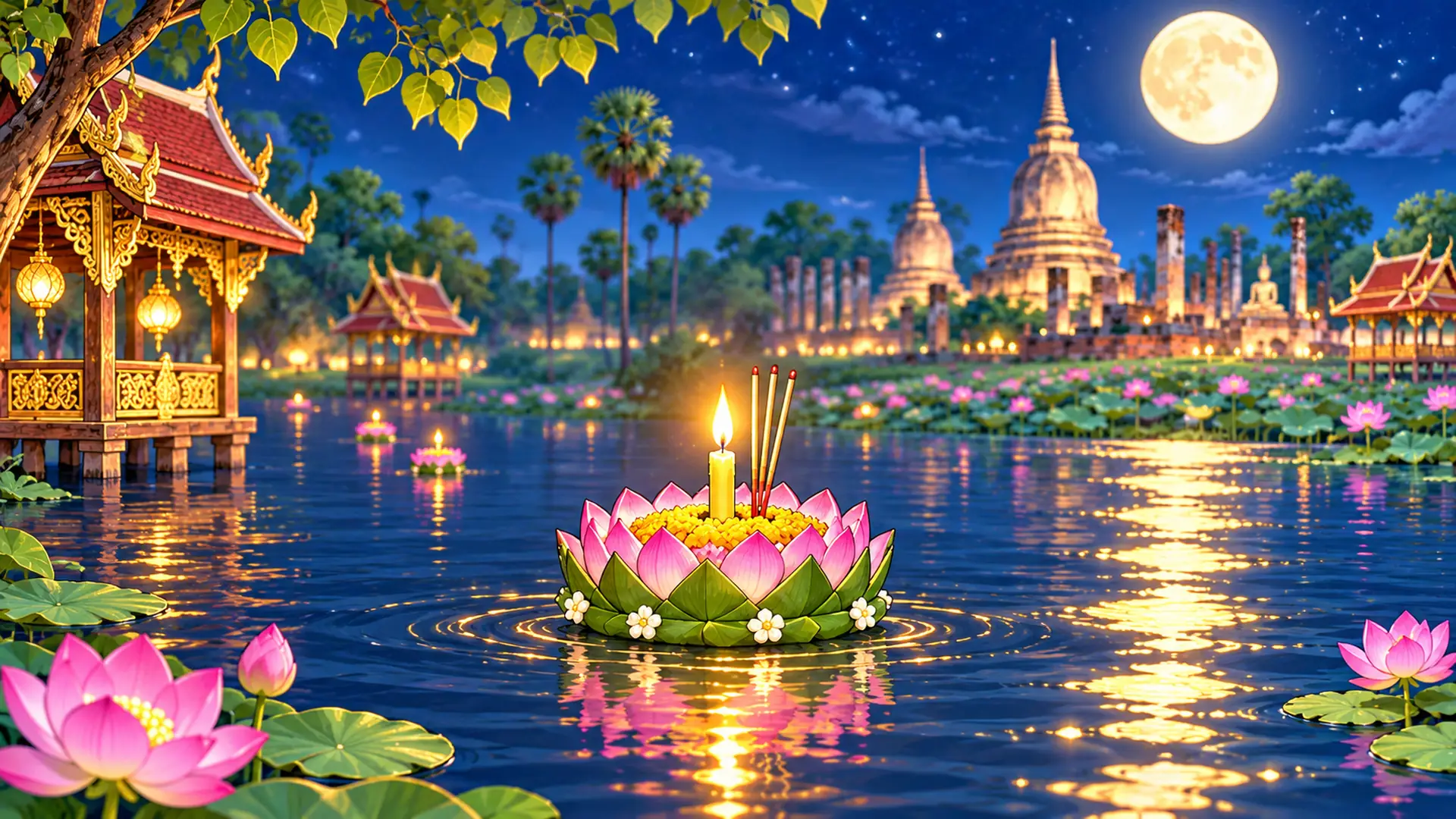
A single small lotus-shaped krathong with its candle flame drifting alone out onto the wide dark river, the reflection of the full moon shimmering beside it, a few other lights beginning to follow far behind, quiet and beautiful.

It drifted out into the dark — a single flame on the black river, with the moon shining beside it.
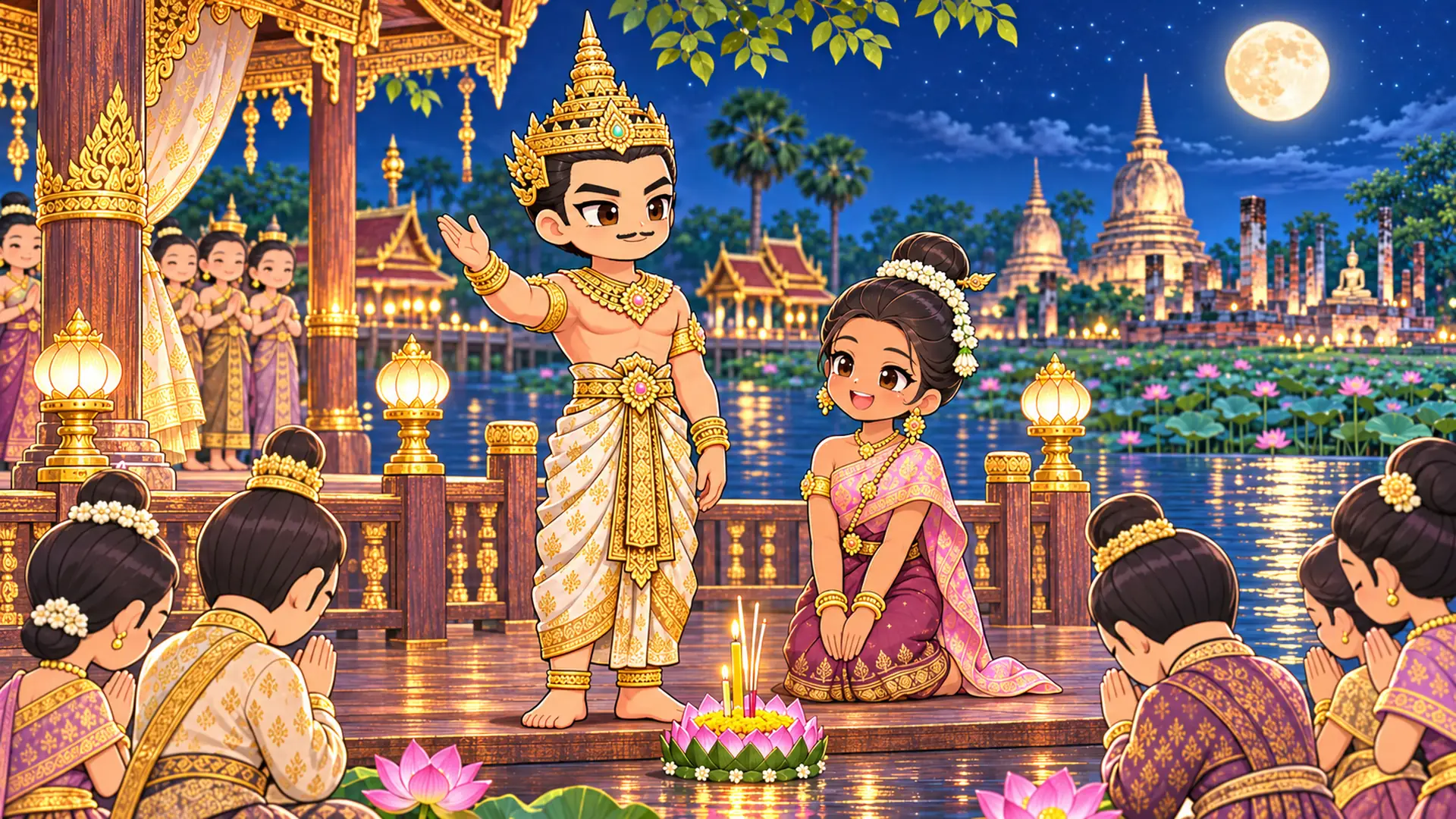
The royal pier at night: King Phra Ruang of Sukhothai standing and raising one hand to make a solemn decree before the kneeling court, Nang Noppamas kneeling at his side, lamps and the full moon behind him, dignified and momentous.

Chapter

Every Year, Forever

Then Phra Ruang made a decree. From that night on, for as long as the kingdom stood, on the full moon of the twelfth month, its kings would float a lotus on the water.
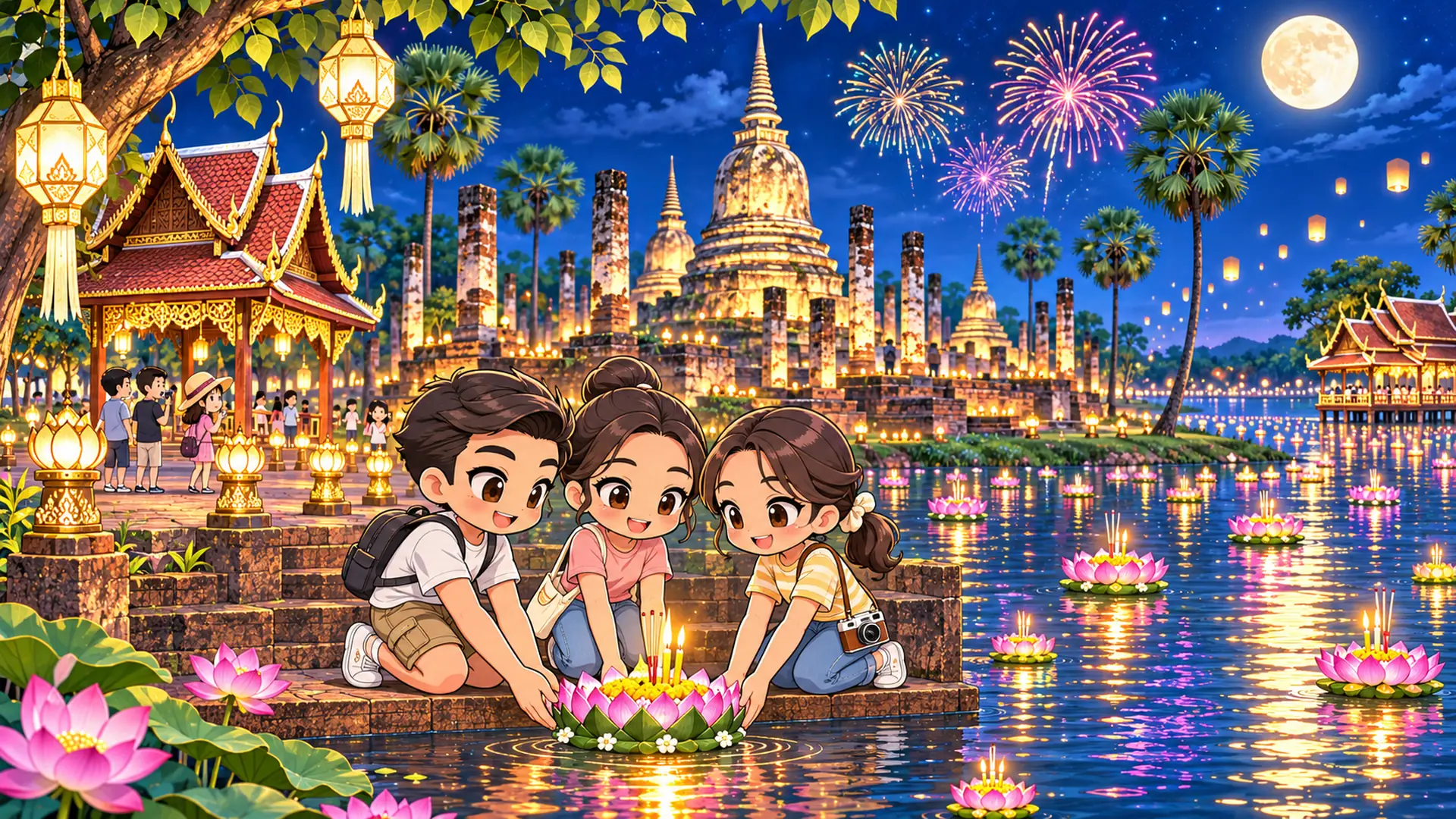
Present day, Sukhothai Historical Park on Loy Krathong night: the ancient lotus-bud chedis and laterite pillars lit by hundreds of candles and lanterns, reflected in the ponds full of floating krathongs, fireworks softly bursting in the sky, a sense of centuries passing — present-day visitors only, in modern casual clothes, small in the scene.

Chapter

Loy Krathong Today

That is how the story goes. Historians believe it was written down centuries later, and that the festival is even older than Noppamas herself. But in Sukhothai, the old ponds still glow with candles every year.
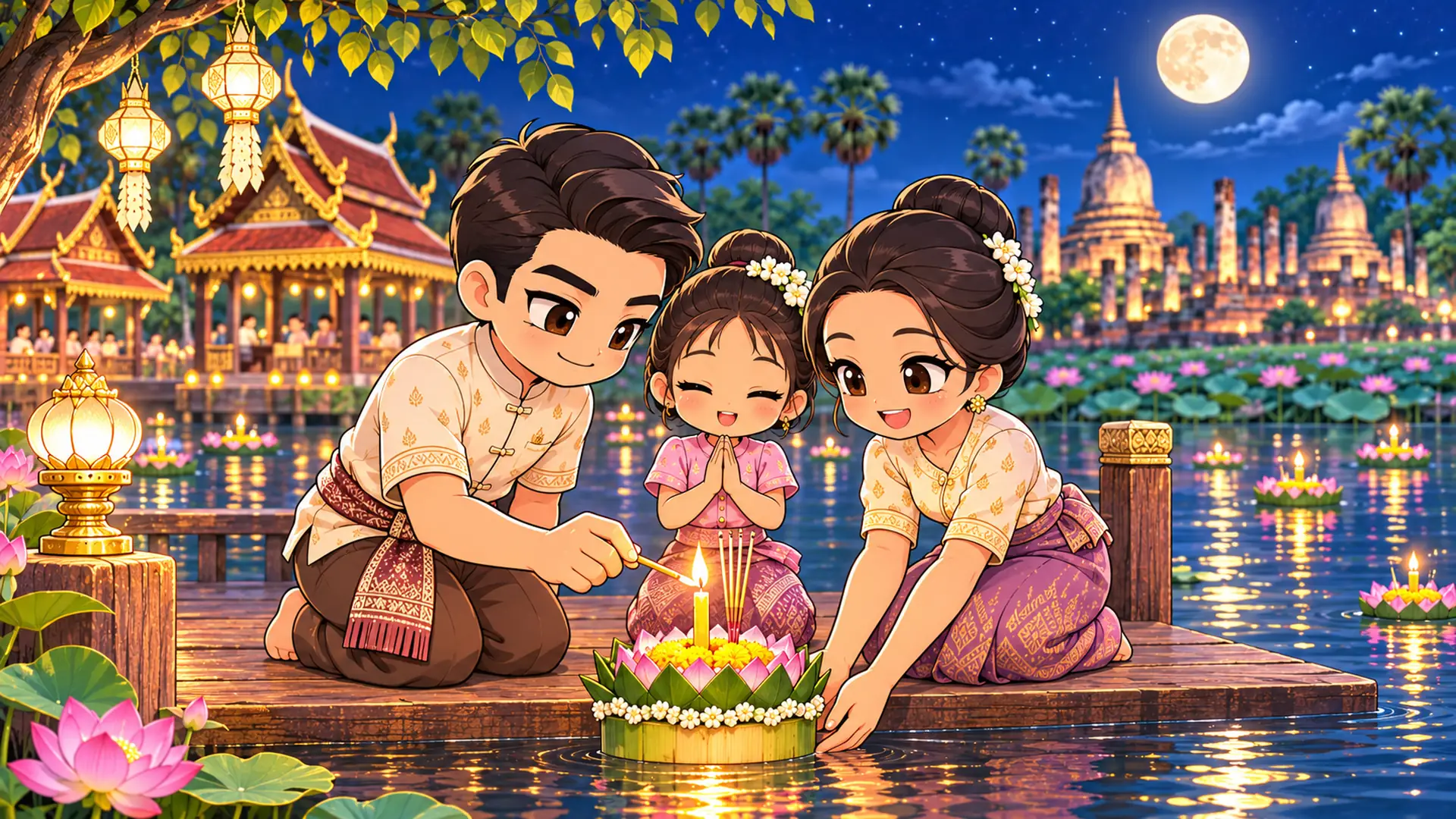
Present-day Thailand at a riverbank on Loy Krathong night: a young family kneeling at the water — a mother, a father and a little girl in simple modern Thai-style clothes — lighting the candle of a krathong made of banana trunk, leaves and flowers, the girl's eyes closed making a wish, other krathongs drifting on the river, warm candlelight.

And all over Thailand, on that full moon, people kneel at the water with krathongs of banana leaf and flowers — these days, sometimes made of bread, for the fish. Some add a coin, or a snip of hair, to float their bad luck away. They light the candle, make a wish… and let it go. Just as she did.
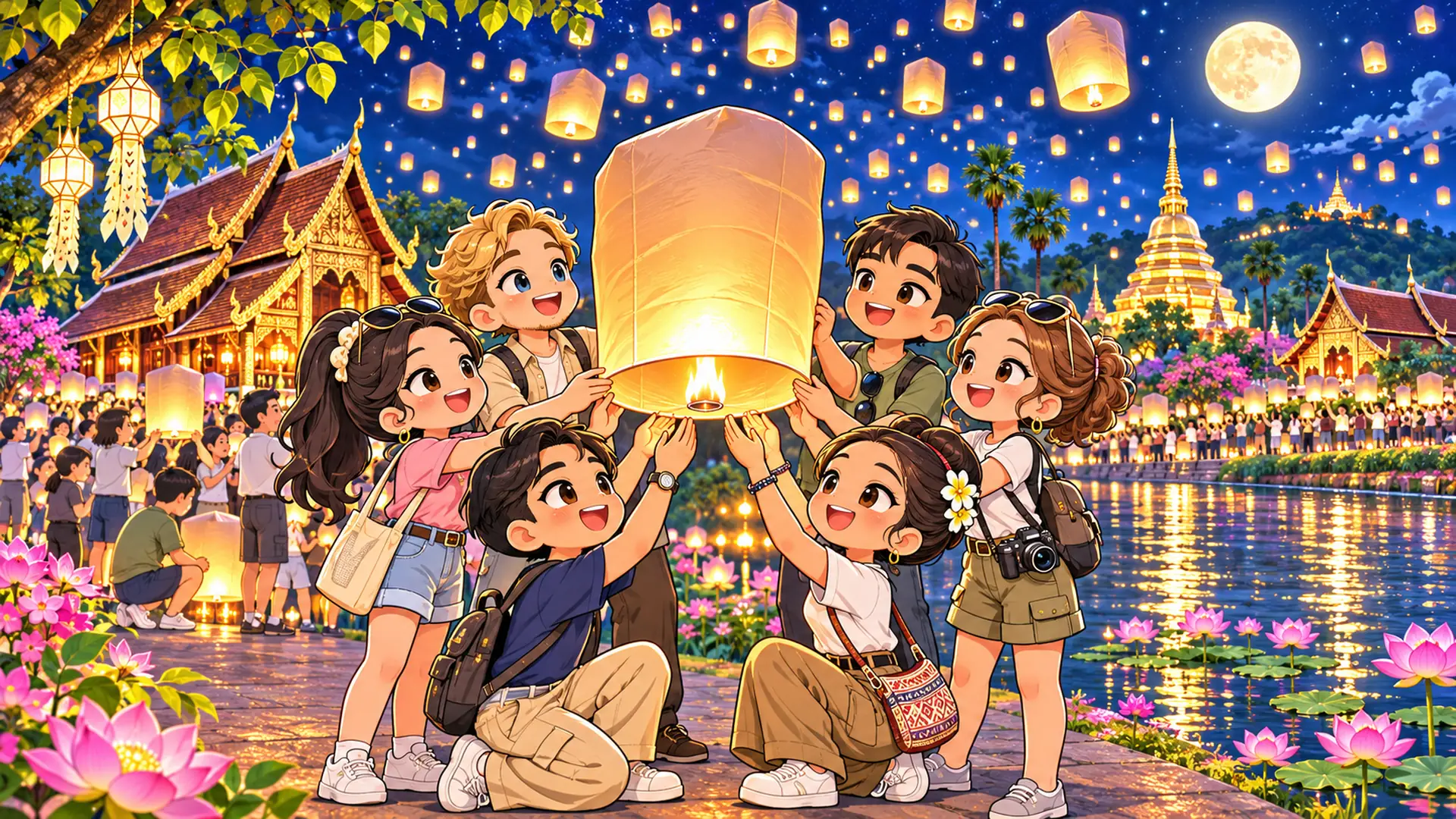
Present-day Chiang Mai on the same full-moon night: thousands of glowing paper sky lanterns rising into the dark sky above temple roofs and a crowd releasing them, the full moon among them, breathtaking — present-day young Thai people and tourists in modern casual clothes releasing the lanterns.

In the north, on the same night, thousands of paper lanterns rise into the sky. And at festival fairs across the country, young women in old Sukhothai dress still compete for one title: Nang Noppamas.

The girl who gave her people a river of lights.